
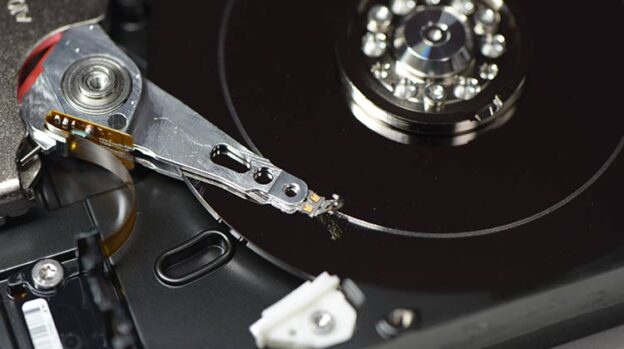
There has always been a great deal said about scratches on hard drive platters and what they mean for data recovery. The most common assumption is simple: once a platter is scratched, the data is gone.
That assumption is no longer accurate for many modern recovery cases.
Scratches remain one of the most serious forms of physical hard-drive damage, but professional recovery tools now provide far more control over individual heads and recording surfaces than was available a decade ago. On supported drive families, a damaged head can sometimes be disabled or excluded while the remaining heads are used to acquire data from healthy surfaces.
The real question is therefore not simply whether a scratch exists. The important questions are where the damage is located, which head reads that surface, whether the required Service Area resources remain accessible, whether the specific drive family supports head isolation, and what data survives on the remaining surfaces.
For a broader discussion of contamination, distributed surface defects, helium drives and other forms of physical media damage, see our Hard Drive Platter Damage Data Recovery article.
How Hard Drive Platters Become Scratched
A platter scratch usually begins with unwanted physical contact between a read/write head and the rotating recording surface.
During normal operation, the heads fly extremely close to the media without sustained contact. An impact, a damaged slider, a deformed suspension, abnormal head alignment, internal contamination or another mechanical failure can disturb that relationship.
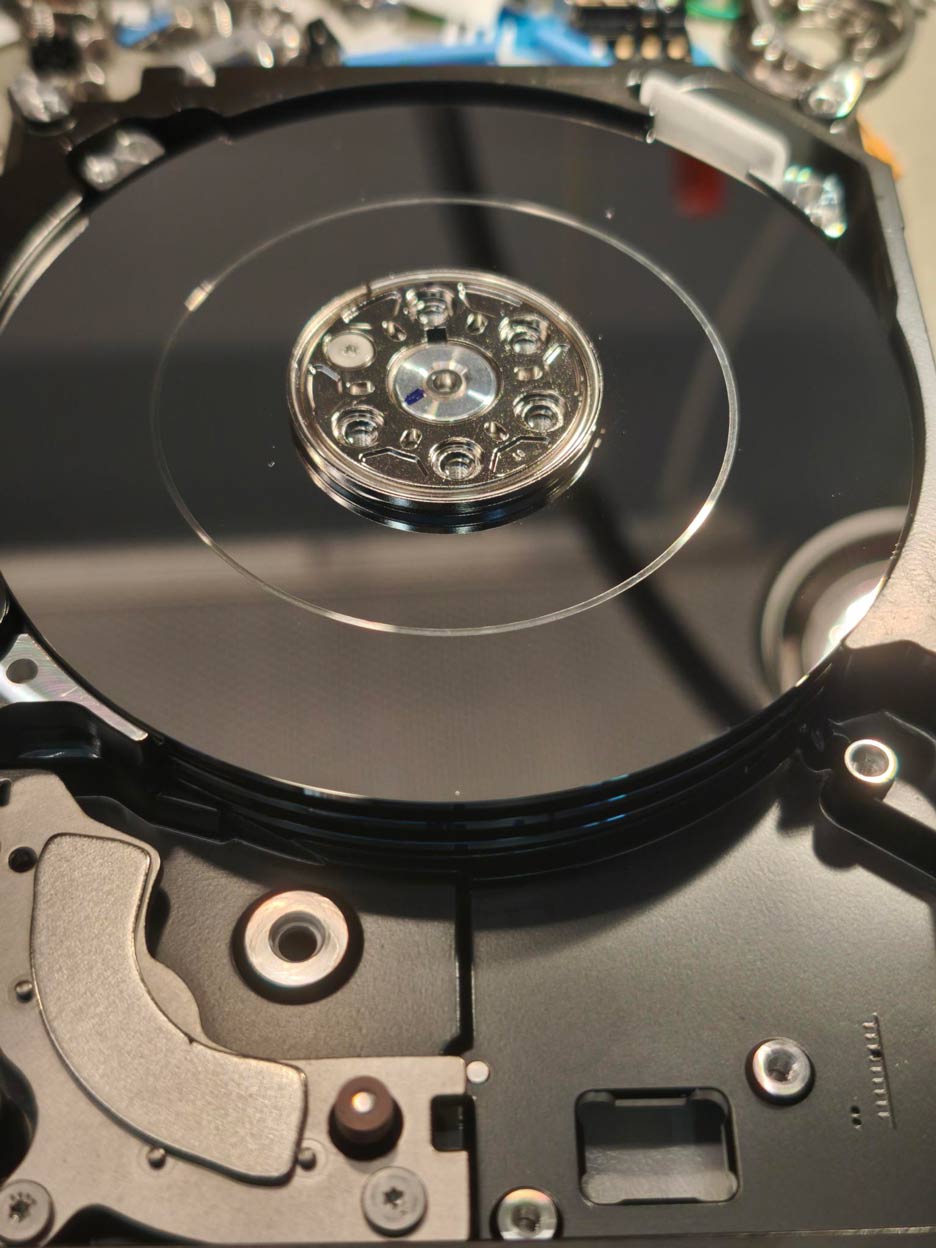
If contact continues while the platter is spinning, the same radius can pass underneath the damaged head thousands of times per minute. A small point of contact can therefore become a continuous circular groove or a series of concentric rings.
This is why repeated power-on attempts are dangerous after a hard drive begins clicking, grinding or scraping following an impact. The condition of the media can change every time the drive spins.
Scratches can also become worse during an unsuccessful recovery attempt. A replacement head that is allowed to repeatedly cross unstable media can fail itself and can contribute to further scoring or contamination.
Does a Scratch Make the Whole Hard Drive Unreadable?
No. The presence of a scratch does not automatically mean that every recording surface or every file has been destroyed.
If magnetic recording material has been physically removed, the sectors stored at that exact location may be permanently lost. But a modern hard drive can contain multiple recording surfaces, each normally associated with an individual head. Damage on one surface does not automatically mean that all other surfaces contain the same damage.
The difficulty is gaining controlled access to the healthy areas without repeatedly sending a damaged or replacement head across unstable media.
Head Control Changed Scratched-Platter Recovery
Scratched-platter recovery is considerably more capable today than it was roughly ten years ago.
Professional tools such as PC-3000 provide family-specific methods for modifying head maps, disabling damaged heads and controlling how supported drives are accessed during imaging.
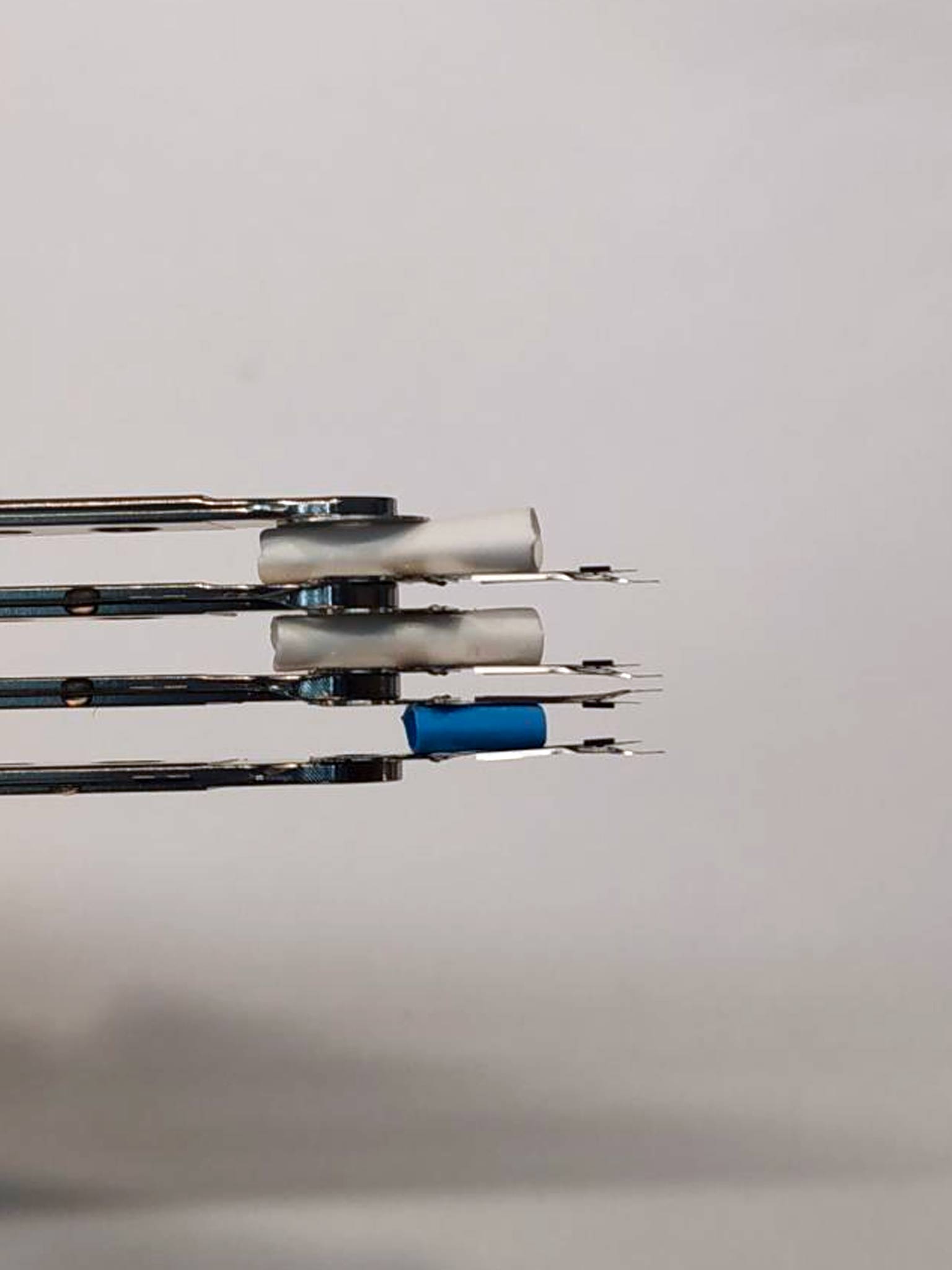
This capability is not universal and it is not automatic. The technician has to know how to perform the procedure correctly, and the specific HDD family must be supported by the version of the recovery tools available in the laboratory.
Professional HDD support develops family by family. A newer model can reach the market before third-party tools expose all of the controls needed to safely work around a damaged head. Later software updates can materially change what is possible on that architecture.
This is one reason two laboratories can reach different conclusions about apparently similar scratched drives. The difference may not be the visible scratch itself. It may be the available firmware support and the laboratory’s ability to isolate the affected head correctly.
The Service Area Comes Before the User Data
The Service Area, or SA, is fundamental to hard-drive recovery. It contains firmware resources required for the drive to initialize and provide meaningful access to the user area.
A hard drive can contain a large amount of physically intact user data on otherwise healthy recording surfaces and still be inaccessible if the critical Service Area resources required to reach that data cannot be obtained.
Service Area damage does not always mean that a case is over. Depending on the manufacturer and drive family, important resources may exist in multiple copies, be accessible through another system head, be read through a loader or alternate procedure, or in some cases be reconstructed.
But there is a hard technical boundary: if the required Service Area information cannot be read, reconstructed, reached through an alternate copy or otherwise made usable, there is no path to meaningful user-data access.
This is why a small scratch in a critical system region can be more consequential than a visually dramatic scratch elsewhere on the disk.
We explain the Service Area in greater detail in What Is a Hard Drive Service Area (SA)? The Hidden Heart of Your HDD.
Why Small Files Often Recover Better Than Large Files
File size matters in scratched-platter recovery.
A small file occupies relatively few sectors. A large file may occupy millions of sectors and may be fragmented into multiple extents distributed across different logical regions of the disk. Those logical regions can ultimately reside on different recording surfaces and be read by different heads.
That becomes especially important when one complete surface has to be excluded.
A 30 MB accounting database, document or photograph occupies far fewer sectors than a multi-gigabyte database, virtual machine or video file. The smaller file therefore has fewer opportunities for one of its required sectors to fall inside the unavailable region.
This does not mean that a small file is guaranteed to survive. If the sectors containing that file happen to be located on the scratched surface, the file can still be damaged or lost.
Large fragmented files face a different problem. Most of the file may exist on perfectly readable media, but a relatively small number of missing fragments can still prevent the complete file from opening or operating correctly.
Fragmentation across recording surfaces is therefore one of the major reasons that scratched-platter cases can produce a very good recovery of small files while larger files remain incomplete.
Why Severe Scratches Often End in RAW Recovery
Even when the Service Area remains accessible and a large percentage of the disk can be imaged, severe scratches do not always end with a clean filesystem recovery.
The unreadable regions may contain filesystem metadata rather than ordinary file content. Directory records, allocation information, parts of the Master File Table or other filesystem structures may be missing even though substantial quantities of user data have been successfully acquired.
In these situations, the physical recovery can be successful while the logical recovery moves into RAW recovery, also commonly described as file carving.
Instead of depending entirely on intact filesystem metadata, recovery software searches the acquired sectors for recognizable file structures and signatures.
This is another reason fragmentation matters. A small contiguous file can often be identified and extracted from RAW data. A large fragmented file may be much harder to reconstruct if the metadata describing how its pieces fit together was stored in an unreadable region.
The Scratch Can Affect More Than the Missing Sectors
A deep score can generate extremely fine media debris inside the HDA.
That material can collect on sliders, move across other surfaces and interfere with stable head flight. A replacement head can therefore fail even when much of the surrounding surface still contains readable data.
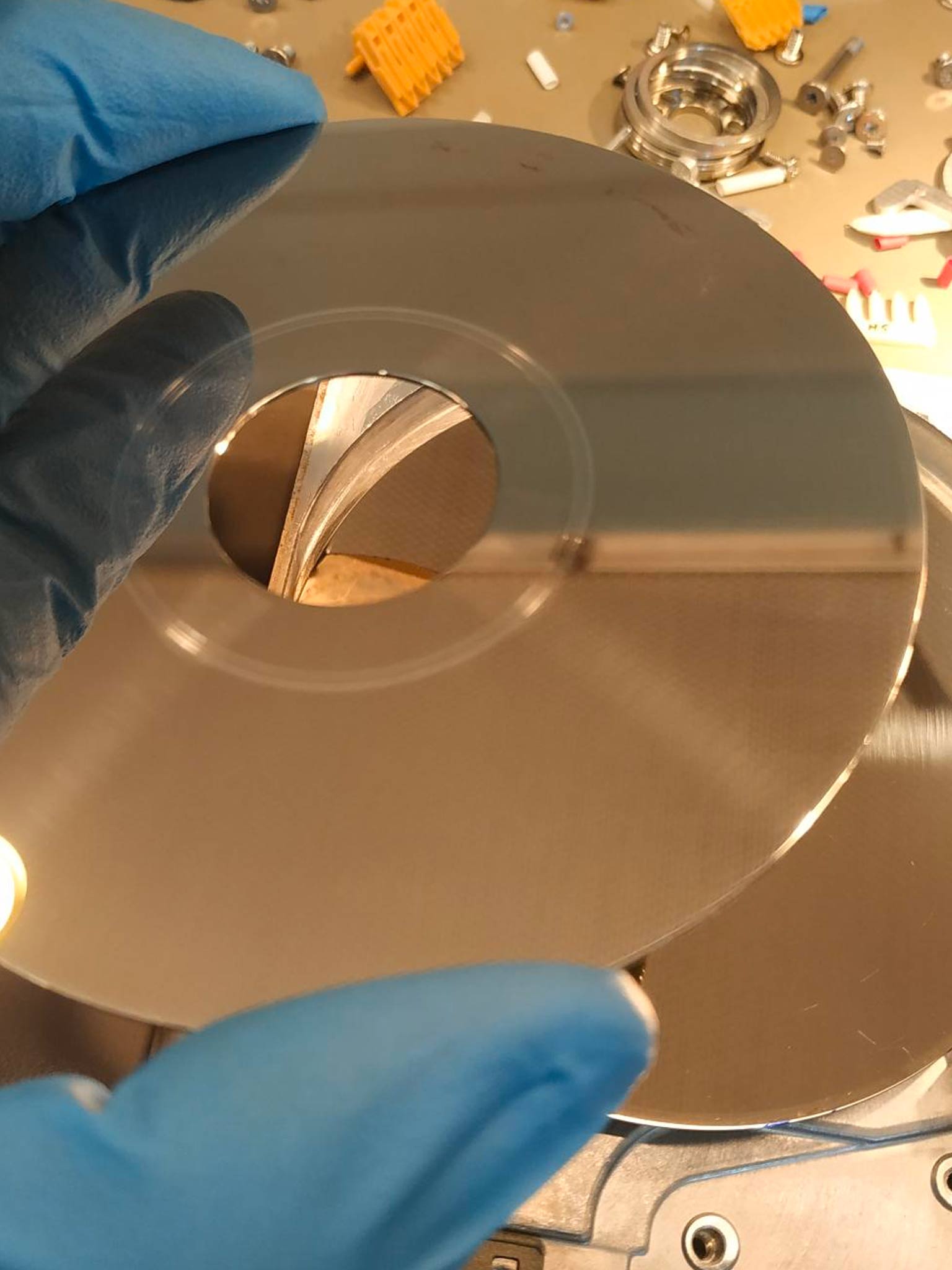
This is why repeatedly installing donor heads into a severely scored drive without addressing the underlying media condition can simply destroy one donor after another.
The objective is not to make the drive behave normally again. The objective is to establish which heads and surfaces remain usable, control access to the damaged regions and acquire the healthiest areas before the available mechanical window closes.
Localized Scratches and Severe Rotational Scoring Are Different Cases
A localized score on one recording surface is not the same failure as deep concentric scoring across several surfaces. Neither is the same as distributed media damage where numerous small defects affect the entire platter stack.
This is why a photograph alone cannot provide a reliable recovery percentage.
A frightening-looking circular scratch may be limited to one surface whose head can be isolated. A much smaller defect can be more consequential if it affects a critical Service Area or servo region required for initialization and access.
The location of the damage inside the drive’s architecture often matters more than how dramatic it appears in a photograph.
Can Scratched Platters Still Be Highly Recoverable?
Compared with a decade ago, many scratched-platter cases are substantially more approachable today.
Professional firmware tooling has improved. More HDD families support individual-head control, head-map modification and controlled imaging around damaged regions. That makes it possible in appropriate cases to stop treating a scratched surface as an all-or-nothing failure.
But there is no universal command that simply turns off any scratched platter on any hard drive.
The laboratory must understand the particular drive family, have current support for it, know how to isolate the affected head correctly, and confirm that the required Service Area remains accessible.
When those conditions line up, a drive with serious visible scoring can still produce a substantial recovery. Sometimes the result is close to complete. Sometimes only selected heads or logical regions can be acquired. Sometimes the endpoint is RAW recovery. And sometimes the recording material or critical firmware resources required for recovery are physically gone.
When Scratched-Platter Recovery Reaches Its Limit
A scratched-platter case reaches its limit when there is no remaining method to obtain useful data without repeatedly destroying the means of reading it.
That can happen when required magnetic recording material has been physically removed, when severe scoring or contamination repeatedly destroys every usable head, when critical Service Area information cannot be recovered through any supported method, or when the required head-control functionality does not exist for that specific drive family.
It is important to distinguish between data that physically no longer exists and data that still exists but cannot currently be reached with the available technology.
A future tool update may change the second situation. It cannot recreate magnetic information that has been physically destroyed.
What Should You Do With a Scratched Hard Drive?
If a drive is clicking, grinding, scraping or has already been diagnosed with platter scratches, stop powering it.
Do not run recovery software against a mechanically unstable HDD. Do not open the drive to inspect the platters yourself, and do not attempt to wipe or clean the recording surfaces.
If another laboratory has already worked on the drive, preserve its diagnostic notes, donor information and photographs if they are available. The history of what has already been attempted can materially affect the next recovery strategy.
Scratched-Platter Recovery at Aesonlabs
We evaluate hard drives with scratched or rotationally scored platters, including drives that have already been opened, attempted or declined elsewhere. The objective is to determine which heads and surfaces remain usable, whether the Service Area can still be accessed, and what level of controlled recovery is technically realistic.
For severe media damage, the realistic result may be a partial recovery or RAW recovery rather than a complete filesystem. That distinction can only be made after the drive’s architecture and physical condition have been evaluated.