
Pitch & Fundamental Frequency
Typical fundamental frequency, usable pitch range, pitch movement and stability may be compared across suitable voiced passages.
Aesonlabs compares questioned speech with known voice material using controlled listening, acoustic measurements and speech-pattern analysis. The objective is to determine whether the available recordings support, conflict with or are insufficient for a proposed speaker relationship.
Speaker comparison is not based on one pitch value, one visible formant or a subjective impression that two voices sound alike. Multiple characteristics are examined across comparable speech, and the strength of any conclusion depends on the quality, duration and suitability of the submitted material.
No single characteristic is treated as a voiceprint. Measurements are interpreted together and within the limitations of each recording.
Typical fundamental frequency, usable pitch range, pitch movement and stability may be compared across suitable voiced passages.
Formant behaviour and resonance patterns can provide information about vocal-tract configuration when comparable vowels and adequate spectral detail are available.
Sentence melody, emphasis, rhythm, pauses and recurring timing habits are examined across natural speech rather than isolated words alone.
Consonant production, vowel realization, reductions, word endings and other recurring articulation patterns may support or conflict with a proposed comparison.
Accent and dialect features may be relevant, but they are behavioural characteristics that can vary with context, language, audience and deliberate disguise.
Breathiness, creak, nasality, vocal effort, speech rate and other qualities are considered while accounting for health, emotion and recording conditions.
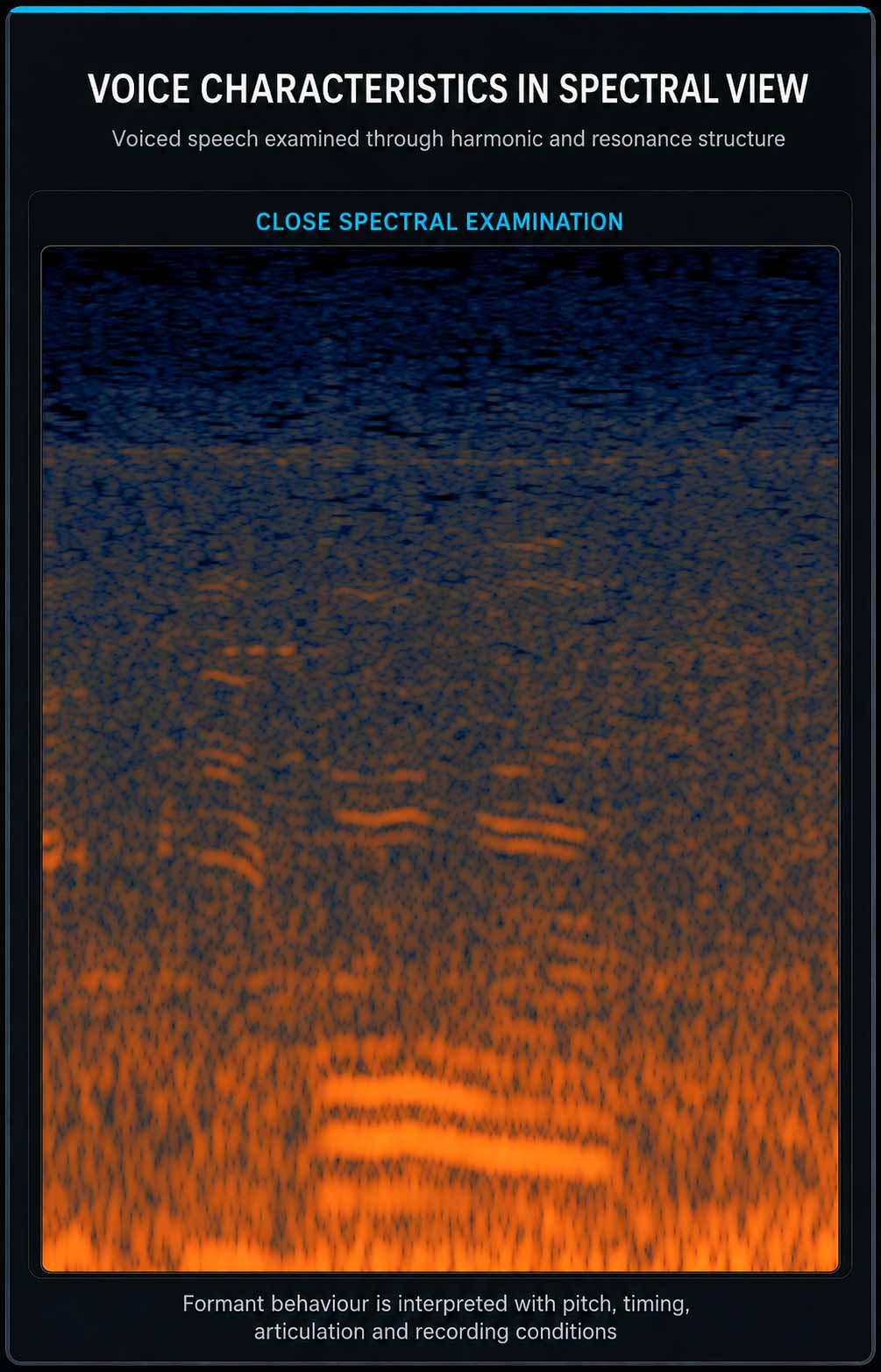
Formants are areas of acoustic energy associated with resonance in the vocal tract. Their positions and movement may be examined when the recordings contain comparable vowels and sufficient frequency information.
The same speaker can produce different measurements because of surrounding sounds, emotional state, vocal effort, illness, microphone position, telephone transmission or compression. Different speakers can also share broadly similar measurements.
For that reason, formant observations are correlated with fundamental frequency, pronunciation, timing, intonation, voice quality and the known recording conditions. The purpose is to evaluate the combined pattern of agreement and disagreement—not to assign identity from one visual feature.
Strong source material cannot be replaced by software. Whenever possible, provide the original files and enough natural speech to evaluate recurring characteristics.
The questioned and known recordings are retained unchanged. File identity, format, duration and available source information are documented.
Speech quantity, clarity, channel quality, compression, background interference and comparability are evaluated before detailed measurements are interpreted.
Relevant speech segments are identified, with preference given to similar phonetic content and comparable speaking conditions.
Controlled listening and appropriate measurements are used to examine agreements, differences and alternative explanations.
Observations are considered together and reported using language proportionate to the quality and strength of the available evidence.
Conclusions are not reduced to a percentage generated by one piece of software.
Features support the proposed speaker relationship. The available agreements may provide support when meaningful unexplained differences are not present.
Features conflict with the proposed relationship. Repeated, technically meaningful differences may support exclusion or another qualified adverse finding.
The material is insufficient or inconclusive. Limited speech, poor comparability or signal degradation may prevent a reliable determination in either direction.
Original submissions are not overwritten. Working copies, selected comparison passages, relevant measurements, screenshots, observations and limitations are maintained according to the agreed scope. When required, a report can identify the material examined, methodology, findings and the basis for the resulting opinion.
Court attendance, testimony, conferences with counsel and preparation for examination or cross-examination are quoted separately. The legal admissibility and ultimate weight of an opinion remain matters for the court or tribunal.
The service compares questioned speech with supplied known material. The strength of any opinion depends on sample quality, quantity and comparability. A recording does not provide an infallible biometric identification by itself.
There is no universal minimum. Several clear passages containing varied natural speech are preferable. A short clip may permit only a limited comparison or no reliable conclusion.
Often they can be examined, but telephone bandwidth, compression, transmission errors and device differences can remove or distort useful characteristics. Similar recording conditions are preferred.
No. Accent can support a broader comparison, but it may be shared by many speakers and can change with context, language, location and deliberate imitation or disguise.
Possibly, but reliability may be substantially reduced because whispering and disguise alter pitch, resonance, articulation and speaking behaviour. Suitable like-for-like known samples are especially important.
Yes. Preservation, examination scope and reporting requirements should be established before work begins. Admissibility remains a legal determination.
Include the source of each recording, the identity represented by each sample, approximate relevant timestamps and whether formal reporting may be required.