Professional SD and microSD Card Data Recovery

Professional SD & microSD Card Data Recovery

Aesonlabs provides professional data recovery from failed, damaged and non-responsive SD and microSD memory cards. We recover photographs, videos, documents and other data from cards affected by controller failure, NAND degradation, electronic faults, monolithic damage, broken internal traces, physical damage, encryption, formatting and filesystem corruption.

SD card recovery can range from relatively straightforward logical recovery to microscopic work on highly integrated monolithic devices. A card that is completely undetectable or even physically broken does not automatically require direct NAND access, and physical damage does not necessarily mean the stored data has been destroyed.

The first objective is therefore to understand what failed before deciding whether the appropriate path involves electronic repair, controller-based access, monolithic pinout recovery, direct NAND acquisition or logical reconstruction.

SD and microSD Card Problems We Recover

Memory cards can fail suddenly or begin showing warning signs such as read errors, corrupted files, incorrect capacity, extremely slow access or repeated disconnections.

The visible symptom does not necessarily identify the actual failure. A completely non-responsive card can have an electronic fault, while a card that still identifies normally can contain severely degraded NAND memory.

SD or microSD Card Not Detected

A card that no longer appears in a camera, computer, card reader or other device may have a controller problem, damaged internal circuitry, NAND failure, broken traces, power-related fault or another condition preventing normal initialization.

The absence of normal detection does not automatically mean that the NAND memory itself has failed.

Card Shows 0 Bytes or the Wrong Capacity

Some failed cards continue to identify but report an incorrect capacity, zero capacity or abnormal device information.

This can occur when the controller cannot correctly initialize the NAND configuration, translation structures or other internal information required to present the logical storage area to the host device.

RAW Card or “Card Must Be Formatted” Message

A card may remain electrically functional while the filesystem or partition structures are no longer recognized correctly.

The operating system may report the card as RAW, unformatted or request that it be formatted before use.

If important data is present, the card should not be formatted simply because the computer or camera requests it.

Slow, Freezing or Unstable SD Cards

NAND flash memory can become increasingly difficult to read as memory cells wear or deteriorate.

A degrading card may become extremely slow, freeze during file transfers, produce read errors or disconnect unexpectedly while the controller attempts to manage unstable memory and increasing error correction.

Repeated copying attempts can place additional stress on a card that is already becoming unstable.

Broken or Cracked microSD Cards

A cracked, chipped or partially broken microSD card can look catastrophic, but recoverability depends on what part of the internal structure has actually been damaged.

If physical damage has destroyed a portion of the NAND die containing user data, the loss may be permanent. However, damage limited to the substrate, contacts, internal traces or another non-storage region may still leave the NAND sufficiently intact for recovery.

This is why physically damaged cards are evaluated using microscopy and, where appropriate, X-ray examination before conclusions are made about recoverability.

Broken microSD card undergoing data recovery evaluation

Water, Corrosion and Electronic Damage

Cards exposed to water, moisture or other liquids can develop corrosion, damaged contacts, short circuits and internal electrical faults.

Repeatedly applying power to a contaminated or electrically abnormal card can cause additional damage, so inspection and electrical diagnosis should come before repeated testing.

Deleted, Formatted or Corrupted SD Cards

When the memory card remains physically healthy, recovery may be possible following accidental deletion, formatting, partition damage or filesystem corruption.

The card should no longer be used once important data has been lost because new photographs, videos or other writes may overwrite information that would otherwise remain recoverable.

How Professional SD Card Recovery Works

SD card recovery begins with diagnosis of the original device rather than immediately assuming that a monolithic pinout or direct NAND procedure is required.

1. Initial Inspection and Diagnosis

The card is examined for physical damage, abnormal contacts, corrosion, cracks and other visible problems.

Electrical behaviour, current consumption and controller response can then be evaluated to determine whether the card is electrically dead, partially responsive or initializing abnormally.

2. Thermal Imaging

Thermal imaging can help identify abnormal current consumption and localized heating within a failed memory card.

A concentrated hotspot may indicate a shorted component, damaged controller, power-circuit problem or another localized fault.

This can prevent a device with a potentially repairable electronic problem from being incorrectly diagnosed as requiring invasive direct NAND recovery.

3. X-Ray Examination

X-ray examination is particularly valuable when the important circuitry and traces are hidden inside a monolithic package.

An X-ray can reveal internal routing, buried conductive paths, component relationships and areas affected by cracks or missing material without immediately removing the protective surface of the card.

For physically damaged cards, this can help establish whether a fracture has crossed important internal structures before microscopic excavation begins.

4. Controller and Electronic Assessment

If the original controller can still communicate or the electrical fault can be repaired, maintaining the original controller path may be preferable to bypassing it.

The controller performs important functions including NAND management, logical translation, error correction and, on some architectures, data transformation or encryption.

Restoring sufficient controller operation can therefore avoid a much more invasive monolithic recovery procedure.

5. Monolithic Pinout or Direct NAND Access

If controller-based access is no longer possible, a monolithic card may require direct communication with the NAND memory through microscopic internal contacts or test points.

This can involve locating an existing technological pinout or developing the necessary signal map specifically for the patient card.

6. NAND Acquisition and Reconstruction

A successful electrical connection to the NAND memory does not automatically produce usable files.

Raw flash data can require error correction, page and block reconstruction, XOR or scrambling analysis, bad-block handling, interleave reconstruction and controller-specific translation before a logical image can be produced.

7. Filesystem Reconstruction and File Recovery

Once a usable logical image has been acquired, it is analyzed for partitions, filesystem structures, directories, photographs, videos and other files.

Whenever possible, subsequent recovery work is performed from the acquired image rather than repeatedly operating the original failed card.

Monolithic microSD Card Data Recovery

microSD cards are highly integrated storage devices. Unlike a conventional flash device containing separate removable NAND packages, much of the controller, NAND and associated circuitry can be integrated into a single monolithic structure.

When normal communication is no longer possible, recovery may require exposing microscopic internal contacts and accessing the NAND memory through a technological pinout.

The procedure is highly dependent on the internal layout of the specific card.

Known and Unknown microSD Pinouts

Some monolithic card layouts have already been researched and documented. In those cases, an established pinout schematic may provide the locations of the required signals.

However, the same retail brand and capacity do not guarantee identical internal construction. Manufacturers can change controllers, NAND memory, routing and substrate revisions while continuing to sell the card under the same product name.

For other cards, no reliable pinout may be available and the required signal layout must be investigated specifically for the device being recovered.

Developing a microSD Pinout

When a usable pinout has not already been documented, the internal structure of the card must be investigated before electrical access can be established.

X-ray imaging, microscopy, electrical measurements and comparison with known architectural characteristics can help identify power, ground, data, command and clock relationships within the monolithic substrate.

The objective is to develop a reliable connection scheme without unnecessarily damaging buried traces or other critical structures.

Microscopic Monolithic Wiring

Once the required points have been identified, the protective material above them can be carefully removed under magnification.

Microscopic conductors are then attached to the exposed contacts so that the required signals can be connected to specialized flash recovery equipment.

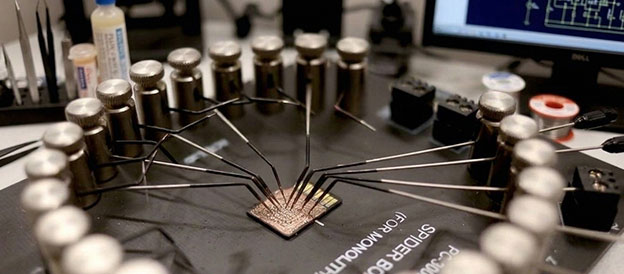
The resulting wired card can look quite dramatic, with numerous fine conductors extending from microscopic points on the monolithic package, but each connection serves a specific electrical function.

Monolithic microSD card wired to NAND pinout test points for data recovery

A Pinout Is Not Always Required

Direct monolithic access is an invasive recovery procedure and should not automatically be the first step simply because an SD card is not detected.

A non-responsive card can be affected by damaged power circuitry, shorted components, failed supporting electronics, broken contacts, damaged traces or another fault that prevents the controller from initializing normally.

If the original controller can be restored sufficiently for controlled acquisition, this may provide a much more direct path to the original logical data.

This diagnostic approach was demonstrated in one of our monolithic SD recovery cases. The card initially appeared completely dead, but thermal imaging and X-ray examination narrowed the problem to microscopic components within the power circuitry. Once the fault was repaired, the original controller initialized and the filesystem became accessible.

View the Full Monolithic SD Card Recovery Case Study

Encryption and Monolithic SD Recovery

Finding the correct monolithic pinout does not guarantee that usable files can be recovered.

A pinout provides electrical access to the flash memory, but additional controller-specific processing may still stand between the physical NAND contents and the logical user data.

Depending on the architecture, raw data may require error correction, descrambling, logical translation and other transformations before a filesystem can be reconstructed.

Encryption can introduce another layer of complexity.

If data stored in NAND depends on encryption performed by the original controller or by the host device, obtaining a successful raw NAND read may still produce data that cannot be directly interpreted without the required encryption context or credentials.

This is one reason preserving or restoring the original controller path can sometimes be considerably more valuable than immediately bypassing it.

Broken microSD Cards and Severe Physical Damage

A physically broken microSD card should not automatically be considered unrecoverable.

microSD cards contain extremely small internal structures, and the effect of a crack or missing piece depends on exactly where the damage occurred.

A broken corner or edge may destroy external contacts or internal traces while leaving the NAND storage area intact. In other cases, the fracture can pass through the NAND die itself and permanently destroy part of the stored information.

The external appearance alone does not always reveal which situation has occurred.

Microscopic examination and X-ray imaging can help determine where the fracture passes through the internal architecture and whether sufficient memory circuitry remains intact for recovery.

When viable, recovery may then involve developing or adapting a pinout, exposing surviving internal contacts and wiring the damaged card directly to specialized recovery hardware.

NAND Degradation and ECC Errors

Not every failed SD card is physically damaged.

NAND memory has finite endurance, and repeated program and erase cycles gradually reduce the electrical margin between stored states.

The controller normally compensates using error correction, wear levelling, bad-block management and other internal processes. As the memory deteriorates, however, increasingly large numbers of bit errors can make pages difficult or impossible to read reliably.

Symptoms can include:

  • Extremely slow file transfers
  • Photos or videos that suddenly become corrupted
  • Repeated read errors
  • Files that cannot be copied
  • A card that repeatedly disconnects
  • A card that becomes RAW or unreadable
  • Intermittent detection

Controlled acquisition allows readable areas to be obtained while unstable regions are handled separately rather than repeatedly stressing the entire card through ordinary file-copy attempts.

Raw NAND Reconstruction

Reading NAND memory directly is only one stage of advanced SD card recovery.

The physical contents of NAND memory may not resemble the logical image originally presented to the camera, computer or other host device.

Depending on the architecture, reconstruction can involve:

  • Error-correction and ECC processing
  • NAND page and block structure analysis
  • XOR or scrambling reconstruction
  • Bad-block handling
  • Interleave reconstruction
  • Logical-to-physical translation
  • Controller-specific data transformations
  • Reconstruction of the original logical image
  • Filesystem and file recovery

A successful physical read therefore does not necessarily mean that the recovery is complete.

Deleted and Formatted SD Card Recovery

SD and microSD cards can also suffer purely logical data loss while the electronics and NAND memory remain functional.

Common situations include accidental deletion, formatting, partition corruption and damaged FAT32 or exFAT filesystem structures.

The card should be removed from service immediately when important files have been accidentally deleted or the card has been formatted.

Continuing to take photographs or record video can overwrite the same physical storage locations containing previously recoverable data.

Camera, Drone, Dashcam and Recording Media Recovery

SD and microSD cards are widely used in devices that continuously produce large amounts of data.

Aesonlabs recovers memory cards used in:

  • Digital cameras and DSLRs
  • Mirrorless cameras
  • Professional video cameras
  • Drones
  • GoPro and other action cameras
  • Dashcams
  • CCTV and surveillance systems
  • Audio recorders
  • Mobile devices and embedded equipment

Loop-recording devices such as dashcams require particular care after an important recording has been deleted or lost. Continued recording can overwrite older video very quickly.

Fake-Capacity and Counterfeit SD Cards

Counterfeit memory cards can be modified to report substantially more capacity than the amount of physical NAND actually installed.

For example, a card may report hundreds of gigabytes of available storage while containing only a fraction of that amount internally.

Once writes exceed the real physical capacity, newly written information may overwrite earlier data or be directed to locations that do not physically exist.

The result can include missing photographs, corrupted videos, damaged files and directories that appear normal until their contents are opened.

Recovery is limited to information that still exists within the genuine physical NAND memory. Data overwritten because of fraudulent capacity reporting cannot be reconstructed from storage locations that were never present.

SD and microSD Cards We Recover

Aesonlabs works with memory cards used across consumer, professional and embedded devices.

Recovery is available for:

  • SD memory cards
  • microSD memory cards
  • SDHC cards
  • SDXC cards
  • microSDHC cards
  • microSDXC cards
  • Monolithic microSD cards
  • Physically broken or cracked cards
  • Cards with damaged contacts or internal traces
  • Water-damaged and corroded cards
  • Cards suffering NAND degradation
  • Formatted or logically corrupted cards
  • Counterfeit or fake-capacity memory cards

We work with cards from manufacturers including SanDisk, Samsung, Kingston, Lexar, Transcend, PNY, ADATA and many other current and legacy brands.

The brand, capacity and exterior appearance alone do not determine the internal architecture or recovery procedure. Different revisions of apparently identical cards can contain different controllers, NAND configurations and monolithic layouts.

What Not to Do With a Failed SD or microSD Card

If the card contains important data:

  • Do not format the card because the camera or computer asks you to.
  • Do not continue taking photographs or recording video after accidental deletion or formatting.
  • Do not repeatedly insert and remove a card that is overheating or intermittently detecting.
  • Do not run CHKDSK or filesystem-repair utilities on an unstable card.
  • Do not repeatedly attempt large file transfers from a card producing read errors.
  • Do not scrape or grind a monolithic card in an attempt to expose test points without understanding the internal layout.
  • Do not apply uncontrolled heat to the card.
  • Do not assume that a cracked or chipped microSD card is automatically unrecoverable.
  • Do not assume that direct NAND access is required simply because the card is not detected.

The correct procedure depends on whether the problem is logical, electronic, controller-related, NAND-related, monolithic or physical.

Why Aesonlabs for SD and microSD Card Recovery?

SD and microSD recovery is performed directly by Aesonlabs rather than being forwarded to an unknown third-party laboratory. Each card is evaluated according to its actual construction, controller behaviour, NAND condition and physical state.

Our recovery work can involve microscopic inspection, electrical diagnosis, thermal imaging, X-ray examination, component-level repair, PC-3000 Flash technology, monolithic pinout development, microscopic wiring, direct NAND acquisition and controller-specific reconstruction.

Cards without an existing documented monolithic pinout are evaluated individually rather than automatically being considered unsupported.

Likewise, severe physical damage is assessed according to what internal structures have actually been affected rather than simply by how damaged the card appears externally.

Customers also have access to a case-management portal where the progress of an active recovery can be followed using the unique case number assigned when the device is submitted.

For customers who cannot bring a memory card directly to our laboratory, shipping options are available throughout Canada. Local delivery and pickup options may also be available depending on location and case requirements.

Starting an SD Card Recovery Case

To begin, submit a recovery case with information about the card and what happened before the data became inaccessible.

If the card is physically cracked, broken, chipped, exposed to liquid or has previously been worked on by another laboratory, include that information when submitting the case.

Photographs of physically damaged cards can also be helpful during the initial intake process.

Once the case is created, you will receive a unique case number and instructions for delivering or shipping the card to Aesonlabs.

After diagnosis, we can determine the nature of the failure and the most appropriate recovery procedure.

SD and microSD Card Data Recovery FAQ

Potentially. A completely non-responsive card can be affected by controller failure, damaged power circuitry, broken internal traces, NAND-related faults or other electronic problems. Diagnosis is required before the appropriate recovery method can be determined.

Sometimes. Recoverability depends on which internal structures were damaged. A broken edge or corner may affect contacts or traces while leaving the NAND memory intact. If the fracture passes directly through the NAND die, however, some stored data may be permanently destroyed.

A monolithic microSD card integrates the NAND memory, controller and supporting circuitry into a compact internal structure rather than providing separate conventional NAND packages. Direct recovery may require microscopic access to hidden test points inside the card.

A technological pinout identifies microscopic electrical points inside a monolithic card that can be used to communicate directly with the NAND memory. Some layouts have known pinouts, while others require the signal scheme to be investigated and developed specifically for the card.

No. A card can fail because of damaged power circuitry, shorted components, broken contacts or another electronic problem while the controller and NAND remain functional. If normal controller operation can be restored sufficiently for imaging, invasive monolithic access may not be necessary.

The internal layout may need to be investigated using X-ray imaging, microscopy, electrical measurements and comparison with known flash architectures. Where technically feasible, a new connection scheme can be developed for the specific monolithic layout.

No. A pinout provides physical access to the flash memory, but raw NAND data may still require error correction, descrambling, logical translation and controller-specific reconstruction. Encryption can introduce additional complications.

Potentially. Recoverability depends on how the encryption was implemented, whether it depends on the original controller or host device and whether any required credentials or encryption keys are available. A successful NAND read alone does not bypass encryption.

Thermal imaging can reveal abnormal current consumption or localized heating, while X-ray examination can reveal internal traces, buried structures and the extent of physical damage. These tools can help identify the actual failure before invasive recovery procedures are attempted.

Depending on the filesystem, subsequent use and physical condition of the card, deleted photographs and videos may remain recoverable. The card should no longer be used because new recordings can overwrite previously stored data.

Potentially. The result depends on the type of formatting, filesystem, subsequent writes and condition of the memory card. Continued use after formatting can overwrite recoverable information.

Recovery time depends on the type of failure, NAND condition, physical damage, monolithic layout and whether electronic repair, pinout development, microscopic wiring or raw NAND reconstruction is required. A more meaningful estimate can be provided after diagnosis.

Get Your SD or microSD Card Evaluated

If your SD or microSD card has stopped detecting, reports the wrong capacity, produces read errors, has been formatted or is physically cracked, broken or damaged, avoid unnecessary repair and repeated testing attempts.

Submit a case to Aesonlabs with the card information and symptoms you have observed. We will evaluate the construction, physical condition and failure of the card and determine the appropriate recovery procedure.

```

Request A Quote Now
Describe Your Data Loss

Thanks! We will contact you soon.
Error: Wrong Answer
Loading...

Subscribe To New Posts

Loading