

Monolithic Flash & microSD Pinout Data Recovery
Aesonlabs provides professional monolithic pinout recovery for failed microSD cards, SD card monoliths and compact USB monolithic devices. Our work includes known-pinout verification, custom pinout research, controlled NAND connection, raw memory acquisition and software reconstruction.
In a monolithic device, the controller, NAND memory and supporting circuitry are embedded together beneath a protective compound. When the normal SD or USB interface stops working, recovery may require direct access to internal test points, a controlled connection to the NAND interface and software reconstruction of the data normally translated by the controller.
Pinout access is not automatically the first step. The device is diagnosed before the package is modified because an undetectable monolith can sometimes have a repairable power, contact or supporting-circuit fault. Direct access is used when the normal interface cannot provide a safe and reliable recovery path.
Different Packages, Different Recovery Challenges
The term monolith describes the construction of the storage device rather than one universal format. microSD cards are the most familiar example, but similar integrated designs are also found inside some full-size SD cards and USB flash drives.
USB monoliths can appear as a small circuit-shaped package inside a conventional enclosure, as a chip-on-board assembly protected by compound, or as a compact device built directly into the USB connector.
Package shape, capacity and exterior markings do not reliably reveal the internal pinout. Devices that look identical can contain different controllers, NAND configurations and connection maps.
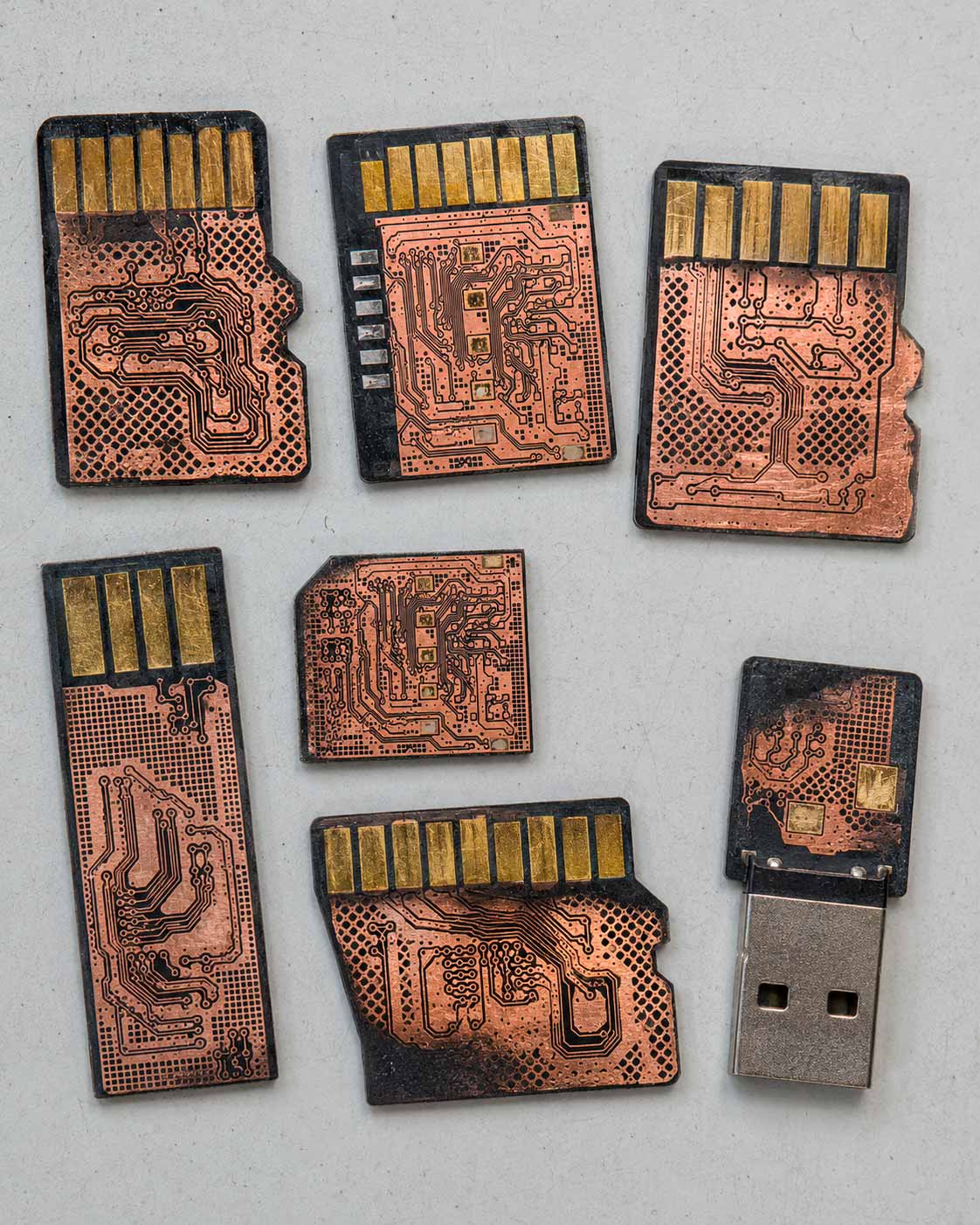
Monolithic Flash Devices We Evaluate
Monolithic recovery may be appropriate when a flash device is physically damaged, completely undetectable or unable to provide stable access through its original interface.
- microSD and monolithic SD memory cards
- COB and single-package USB flash drives
- USB monoliths integrated into the connector
- Cards with broken, worn or missing external contacts
- Cracked, bent, corroded or liquid-damaged monoliths
- Devices that are not detected or fail to initialize
- Devices with controller, power-rail or internal circuit faults
- Previously opened, exposed or partially worked-on monoliths
Recoverability depends on the location and severity of the damage. A broken connector or inaccessible controller presents a different situation from a fracture that passes through the NAND array or destroys the internal traces required for direct access.
Diagnosis Before Pinout Access
A completely dead card does not necessarily have failed NAND memory. Before exposing internal points, we inspect the device, test its external contacts and power rails, and evaluate whether a supporting-circuit repair could restore communication through the original controller.
In one Aesonlabs case, an undetectable SanDisk monolithic SD card had a direct short between its supply rail and ground. Thermal imaging localized the heat source, X-ray inspection showed embedded components in the same area, and microscopic work identified two failed capacitors. Removing those components cleared the short and allowed the original controller to initialize.
That case did not require direct NAND access. It demonstrates why pinout work should follow diagnosis rather than replace it. The complete recovery is documented in our monolithic SD card data recovery case study.
Known Pinouts Are Verified; Unknown Pinouts Are Researched
Some monoliths have already been mapped by equipment manufacturers, laboratories or technical researchers. When a reliable reference exists, it can provide a starting point for identifying power, command and data connections.
An online diagram is not treated as proof that two cards share the same internal layout. Revisions, controller changes and manufacturing differences can exist beneath identical exterior markings, so relevant connections must still be verified on the actual device.
When no dependable map is available, we research and prepare the connection map for the monolith. Custom pinout determination is an additional engineering stage and can substantially extend the recovery process.
Preparing a Monolith for Direct Access
When pinout recovery is required, a controlled area of protective compound is removed under magnification to reveal the internal test pads or traces. The preparation method depends on the construction of the device and the expected location of the required access points.
This is precision work. Removing too little material may leave the contacts inaccessible, while grinding too deeply can erase test pads, cut traces or damage the NAND itself. Preparation is limited to the area needed for the selected access method.
If another recovery attempt has already been made, photographs and details of any grinding, soldering, heating, probing or power injection should be supplied with the device. Previous work does not automatically prevent recovery, but it can change the available options.
Connecting the Monolith With the PC-3000 Spider Board
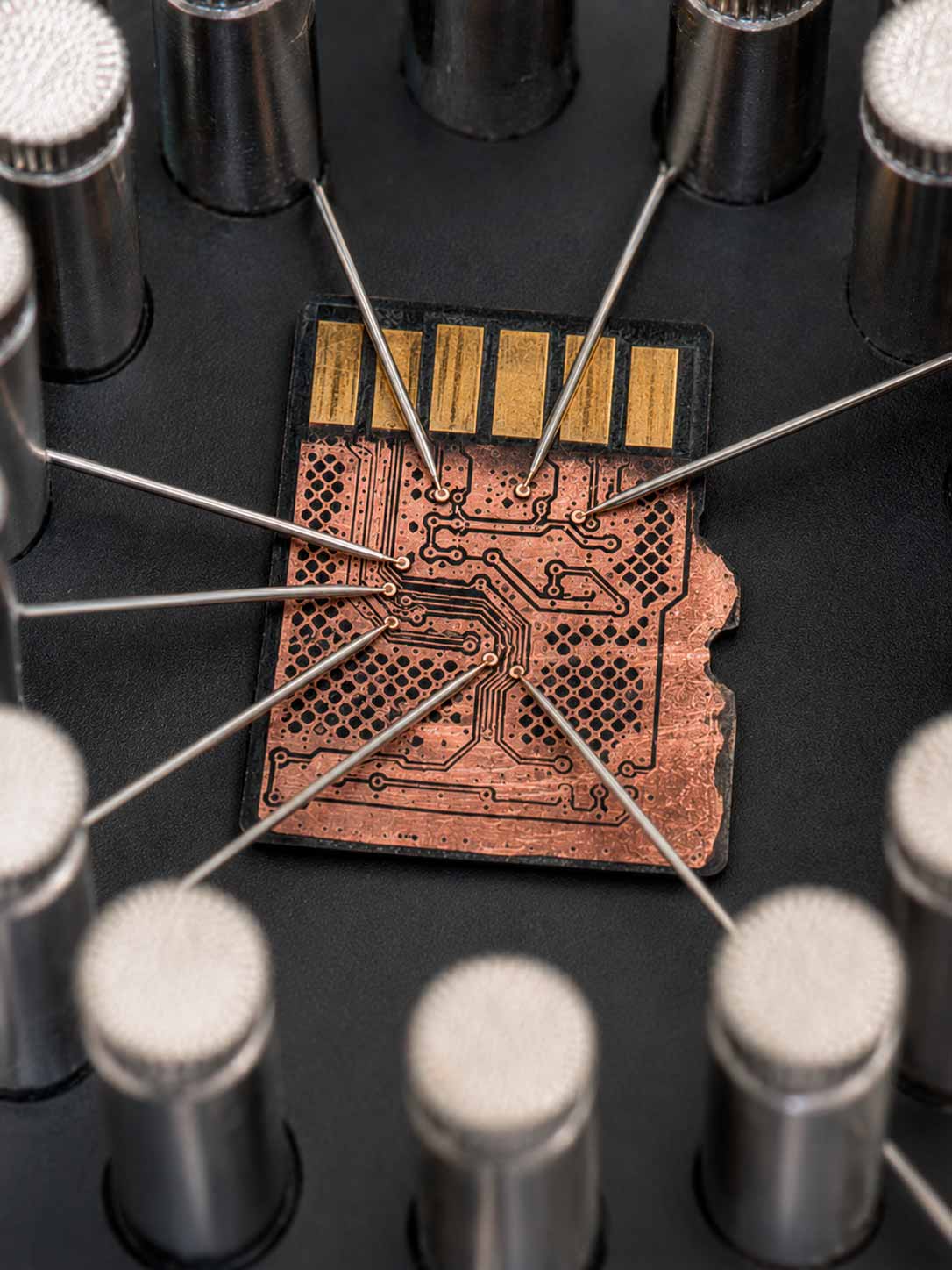
After the access points have been exposed and identified, the monolith can be connected to professional NAND-reading hardware. The PC-3000 Spider Board uses individually positioned probes—often described as spider legs—to contact the required points on the device.
The probes can be assigned to the appropriate power, command and data signals for the selected pinout. Contact quality and connection configuration are checked before reading begins.
A probe-based connection can reduce unnecessary soldering, but it does not remove the need for careful preparation, accurate signal identification and stable electrical contact throughout the acquisition.
Reading the Raw NAND Memory
Once a stable connection has been established, the NAND is identified and read independently of the failed storage controller. The read configuration depends on the memory architecture, voltage requirements, number of banks or dies and the condition of the cells.
A degraded monolith may not produce an identical result on every pass. Unstable pages can require adjusted reading parameters, repeated acquisition and comparison of multiple reads. Larger devices may contain more memory areas to address and substantially more raw data to acquire.
Obtaining a raw read is a major step, but it does not mean the folders and files are immediately available. The controller normally performs several transformations between the NAND and the logical sectors presented to the camera, phone, computer or recorder.
Software Reconstruction of the Controller's Data Layout
A raw acquisition can contain page data, spare areas, error-correction information, scrambled content, interleaved structures and controller-specific block organization.
Depending on the device, reconstruction can require ECC processing, XOR or scrambling removal, page and block reordering, interleave handling, bad-block processing and recreation of the controller's logical translation.
When a logical image has been assembled, the filesystem, folders and files are examined. If important metadata is damaged, additional filesystem reconstruction or file carving may be required.
Encryption and Monolithic Recovery Limitations
Encryption can become a fundamental limitation when direct NAND access bypasses the original controller or host device. Some flash controllers transform or encrypt information before it is written to NAND. Data can also be protected by encryption applied by the phone, computer, recorder or other device that used the card.
In those situations, it may be possible to obtain a complete raw acquisition while the underlying content remains encrypted. If the required key is unavailable or tied to a failed controller or host device, reconstruction of usable files may not be possible.
Other limitations include physical damage to the NAND array, destroyed internal traces, missing access points, severe cell degradation, unknown controller translation and incomplete reads affecting critical filesystem or file data. No responsible result can be promised before the condition and organization of the device are understood.
Why Monolithic Recoveries Can Take a Long Time
Turnaround is determined by more than the storage capacity printed on the device. A known, stable pinout can progress very differently from an undocumented monolith requiring custom mapping and repeated reads from degraded NAND.
- Researching or verifying an undocumented pinout
- Carefully exposing the required internal contacts
- Troubleshooting unstable probe or electrical connections
- Reading large-capacity, multi-bank or multi-die NAND
- Repeating reads to improve unstable or error-filled pages
- Manually analyzing an unsupported controller layout
- Reconstructing damaged filesystem structures
- Evaluating encryption or incomplete raw acquisitions
Some known-pinout cases can move through acquisition and reconstruction relatively efficiently. High-capacity, unstable or undocumented devices can require considerably more engineering and processing time, and some recoveries may continue for weeks. A more meaningful estimate can be provided after diagnosis and initial technical work.
What Not to Do With a Failed Monolithic Device
The internal traces and access points in a monolith are extremely small. Improvised preparation or electrical testing can turn a recoverable device into one with permanent internal damage.
- Do not format or initialize the card when prompted.
- Do not repeatedly reconnect an unstable or overheating device.
- Do not sand, grind or scrape the package to search for contacts.
- Do not solder to unknown points or apply unverified voltage.
- Do not run repair utilities against a card that disconnects or reports read errors.
- Keep all broken pieces, housings, connectors and adapters with the device.
Why Aesonlabs for Monolithic Pinout Recovery?
Monolithic recovery combines electrical diagnosis, microscopic preparation, direct NAND acquisition and controller-level software reconstruction. These stages are performed directly by Aesonlabs rather than forwarding the device to an unknown third-party laboratory.
Each case is approached according to the actual construction and condition of the device. Known references are verified, undocumented pinouts can be researched when appropriate, and direct access is not performed when a safer recovery path remains available.
Customers can follow an active case through our case-management portal using the unique case number assigned when the device is submitted. Shipping options are available throughout Canada, and local drop-off is available by appointment.
Starting a Monolithic Flash Recovery Case
Submit a recovery case with the device type, manufacturer, capacity and symptoms. Tell us what happened before it failed, whether it is detected anywhere, whether the package or contacts are physically damaged, and whether another recovery attempt has been made.
It is also helpful to identify the phone, camera, recorder, computer or other equipment that used the media, particularly when encryption may be involved. Include the types of files needed and any folders or dates that are especially important.
Monolithic Flash Data Recovery FAQ
A monolithic flash device integrates the controller, NAND memory and supporting circuitry into one sealed package rather than placing separate components on an accessible circuit board. microSD cards are a common example, although monolithic construction is also used in some SD cards and USB flash drives.
No. The failure may involve a contact, power rail, passive component or other supporting circuitry. Diagnosis determines whether the original controller can be made accessible or whether direct NAND access is required.
Potentially. An undocumented monolith may require custom pinout research using electrical measurements, trace analysis and device-specific testing. This adds engineering time and does not guarantee that every required connection can be identified or used successfully.
Recoverability depends on where the device fractured and whether the NAND array, required traces and access points remain intact. The complete card and every available broken piece should be preserved for evaluation.
No. Raw NAND content normally requires error correction, descrambling, block and page reorganization, controller translation and logical image assembly. The filesystem and files can be evaluated after that reconstruction is completed.
Yes. The raw NAND may contain encrypted content written by the controller or the original host device. If the necessary key is unavailable or tied to failed hardware, a successful raw read may not be convertible into usable files.
Time depends on whether the pinout is known, the amount of preparation required, NAND capacity and condition, reading stability and reconstruction complexity. Difficult undocumented or high-capacity cases can require weeks of engineering, acquisition and processing.
Yes. Previously worked-on devices can be evaluated, but damaged contacts, excessive grinding, cut traces or unsuitable power application may reduce the available recovery options. Provide details and photographs of the previous work whenever possible.
Get Your Monolithic Device Evaluated
If your microSD card, SD card or monolithic USB device is no longer detected, is physically damaged or contains inaccessible data, stop unnecessary testing and preserve the device in its current condition.
Submit the device information and failure history to Aesonlabs. We will evaluate the available recovery paths and determine whether interface repair, pinout access, custom mapping or direct NAND reconstruction is appropriate.