

Platter damage is often treated as a visual diagnosis: the platter is scratched, therefore the drive is either recoverable or it is not. In practice, the visible damage is only one part of the problem.
Two drives with similar-looking scratches can have completely different recovery prospects. A drive with severe damage on one recording surface may still provide access to data stored on the remaining heads if that damaged head can be isolated. Another drive may have almost pristine user-data surfaces but be inaccessible because the Service Area needed to initialize the drive or translate logical addresses has been destroyed on a critical system surface.
The questions that matter are more specific. Which surface is damaged? Which head reads it? Can that head be excluded from initialization and imaging? Is the Service Area still accessible? Does professional recovery tooling support the drive family well enough to control the failure? What does microscopic examination of the heads reveal about contact with the media? Can the remaining surfaces be read without repeatedly damaging replacement heads?
Those questions usually matter more than the simple presence or absence of a visible scratch.
What Platter Damage Actually Means
A hard disk stores user data magnetically on one or more rotating platters. Each platter normally has one or two recording surfaces, with a separate read/write head assigned to each active surface.
During normal operation the heads fly extremely close to the media without touching it. Physical contact, contamination, loose debris, coating failure, deformation or damage caused by a previous repair attempt can disturb that relationship and make parts of the recording surface unreadable.
Some platter damage is obvious. Deep concentric rings created by a head crash can be visible immediately after opening a drive. Other damage is much less dramatic: small distributed defects, localized coating loss, fine scoring, contamination or debris may be enough to destroy heads or interrupt reading even though the surface does not look catastrophically damaged.
The most important distinction is between damage to the user recording area and damage to the parts of the drive needed to make the user area accessible in the first place.
That distinction is where many simple explanations of platter recovery become misleading.
The First Question: Can the Drive Still Initialize?
Before meaningful imaging can begin, a modern hard drive has to initialize its internal firmware environment.
Part of that firmware resides in ROM or non-volatile memory on the PCB. Other critical resources are stored in the Service Area, or SA, on reserved regions of the platters. Depending on the manufacturer and family, those resources can include adaptives, translator-related information, defect data, overlays, configuration data and other structures required for normal access to the user area.
If a user-data surface contains a scratch, the result may be loss of sectors associated with that surface.
If a critical SA region becomes inaccessible, the result can be much more fundamental: the drive may no longer reach a state where the healthy user area can be addressed at all.
This means a multi-platter drive can theoretically contain a very large amount of physically intact user data and still be unrecoverable with the available methods because the firmware information required to reach that data cannot be obtained.
Service Area damage does not automatically mean the case is over. Some drive families keep multiple copies of important modules, use different system heads, permit loader-based access, or provide other ways to work around a weak SA copy. In some cases individual resources can be reconstructed or read through an alternate method.
But there is a hard limit. If the critical SA information required for initialization or translation is destroyed, no usable alternate copy exists, and the available tooling cannot reconstruct or bypass it, clean user platters do not solve the problem.
The data can physically exist and still be inaccessible.
One Damaged Surface Does Not Always Mean Losing the Whole Drive
Each active recording surface is normally associated with a specific physical head.
If one surface is damaged while the others remain readable, an ideal recovery strategy is often to stop the drive from using the affected head and acquire the healthy surfaces first.
Professional tools such as PC-3000 and Data Extractor can build head maps and identify which logical areas correspond to individual heads. That allows imaging to be prioritized by head and can prevent unnecessary reads from known bad areas.
However, a logical head map inside an imaging task is not the same thing as disabling a physical head at firmware level.
If the drive has already initialized successfully, a Data Extractor head map may be enough to image only the healthy heads. But if the bad head is required during startup, repeatedly accessed by the firmware, or prevents the drive from reaching a stable ready state, simply excluding that head from an imaging map does not remove the underlying problem.
Not every family exposes the same level of control. That is why a single damaged surface may be relatively manageable on one drive architecture and a much larger problem on another.
Head Inspection Can Tell a Bigger Story
A visible platter surface is only one source of evidence.
The condition of the head assembly can reveal what has been happening inside the drive, particularly in a multi-platter design where unnecessary removal or separation of individual platters would add risk.

Under magnification, the sliders may show crash dust, transferred coating material, contamination, residue or abnormal wear. Debris concentrated on one head can suggest severe contact with the corresponding surface. Material on several heads can indicate a wider contamination or media-damage event rather than an isolated defect on the upper visible platter.
This does not mean that a microscope image can map every scratch or prove the condition of every recording surface. Head inspection is one part of the diagnosis, but it can provide important evidence before deciding how far an internal examination should go.
That matters because a multi-platter assembly is not something to dismantle casually. On drives where platter relationships and mechanical alignment must be preserved, taking the stack apart simply to inspect every surface can introduce a new recovery problem.
Tool Support Is Part of the Recovery Equation
PC-3000 is widely used as a professional platform for hard-drive firmware work and controlled imaging, but it is not a universal command key for every HDD ever produced.
Modern drives are highly proprietary devices. Their firmware architectures, internal commands, adaptive data, translators and Service Area layouts vary by manufacturer, family and generation.
Support therefore develops family by family.
A drive can reach the market before third-party recovery platforms expose all of the controls needed to work around a damaged head or inaccessible firmware resource. Later software releases may turn a previously impractical case into one that can be approached in a controlled way.
Recovery-tool vendors continue to add new families, new head-map controls, new Service Area access methods and new ways to work around damaged surfaces.
Current PC-3000 functionality includes the ability to disable damaged heads on supported families by building or altering head maps. On supported WD Marvell and SMR drives, cylinder mapping can also be used to control reading around damaged regions and reduce unnecessary head degradation.
Drive manufacturers also work with proprietary engineering information, factory firmware resources and internal procedures that are not necessarily available to independent laboratories. The capabilities available inside a manufacturer’s own engineering or recovery environment can therefore differ from those available through third-party professional tools at a given point in time.
Platter Damage and the Service Area
The Service Area deserves separate attention because it creates some of the least intuitive platter-damage cases.
Consider a drive with many recording surfaces. Most of the user area may be physically clean. Only one surface has serious damage.
If that damaged surface contains ordinary user sectors, it may be possible to exclude that head and recover the remaining surfaces.
If that same surface contains the only readable copy of firmware resources required to initialize the drive, the situation can be completely different.
The user data on the other surfaces has not disappeared. The problem is that the drive cannot establish the internal state required to address it.
This is why statements such as “only one platter is damaged” can be meaningless without knowing which surface is damaged and what that surface contains.
The reverse is also true. A drive can show visible scratches in part of the user area and still have an intact Service Area, stable initialization and multiple healthy heads. That case may support a substantial partial recovery even though the physical damage looks dramatic.
The location of the damage inside the drive’s architecture is often more important than how alarming it appears in a photograph.
Scratches and Rotational Scoring
The most recognizable platter damage is circular or concentric scoring.
This commonly develops when a damaged slider, part of the head assembly or loose debris contacts a rotating surface. Once contact begins, continued rotation can deepen the same path and distribute additional debris through the HDA.

A scratch has at least two consequences. The first is direct loss of magnetic recording material. If the recording layer containing particular sectors has been physically removed, those sectors cannot be reconstructed from that location on the platter.
The second is instability. Damaged media can contaminate or destroy the head attempting to read it. A surface that contains a small unreadable region may therefore prevent access to a much larger amount of otherwise intact data if every replacement head is damaged while crossing that region.
The imaging strategy has to minimize access to known damaged areas, prioritize healthy surfaces and stop when continued reading is doing more harm than useful work.
Localized and Distributed Surface Damage
Not all severe media damage forms a ring.
Small point defects, coating irregularities and distributed surface damage can be difficult to see without careful inspection. They may still interfere with head flight or destroy a replacement head after only a short period of reading.
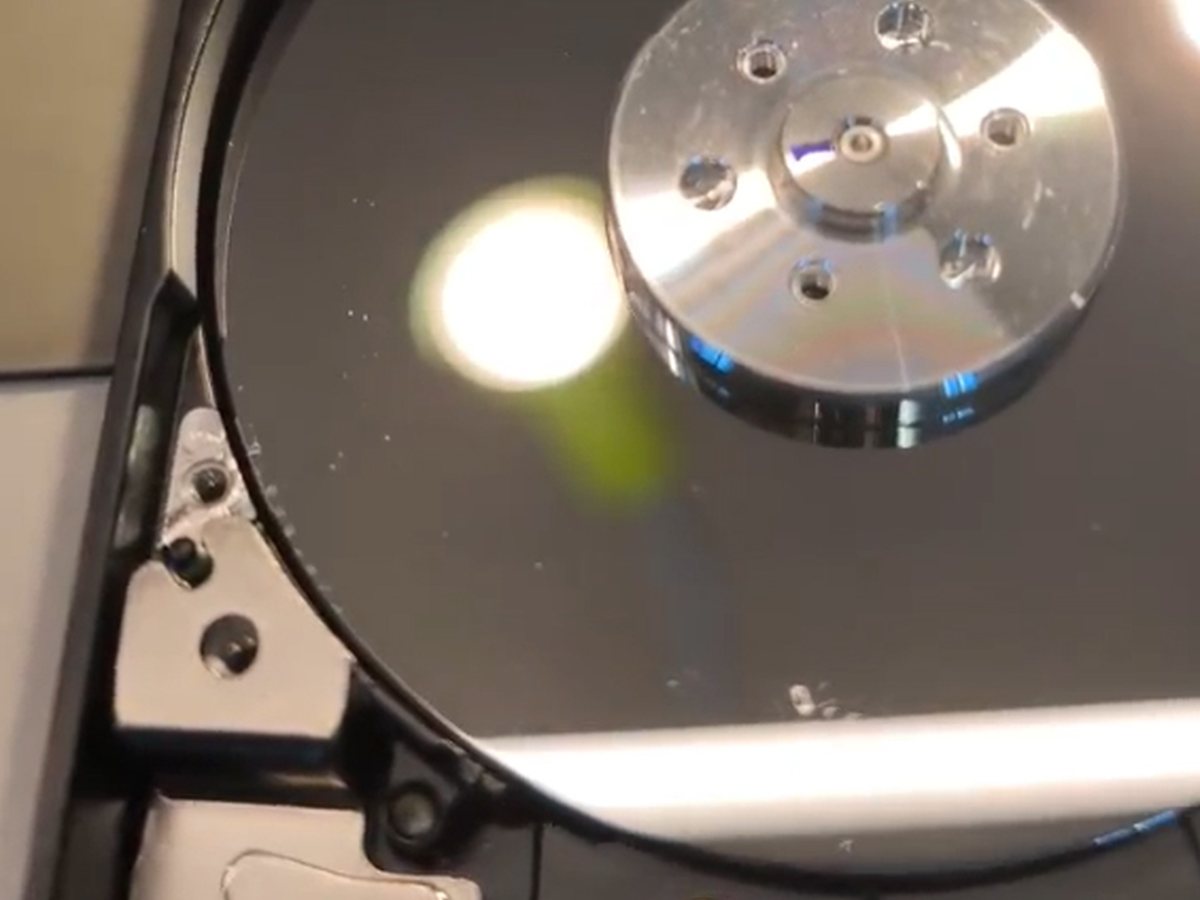
Aesonlabs encountered this in a WD VelociRaptor case where the visible upper surface did not show the classic deep concentric scoring associated with a conventional head crash. Closer inspection of the complete platter stack showed small physical defects distributed across every recording surface.
The problem was not one dramatic scratch. It was the condition of the media as a whole. Additional donor heads could not change that condition, and the case was closed as physically unrecoverable.
Read the complete WD VelociRaptor platter-damage case study.
Dust, Debris, Fingerprints and Residue
A platter does not need to lose magnetic coating to become unsafe to read.
Particles generated during a head crash can circulate inside the drive and collect on other surfaces or on the sliders themselves. Dust, fingerprints, oils or residue introduced during an uncontrolled opening can create a second problem on top of the original failure.

The significance of contamination depends on its location, quantity and whether the drive was subsequently operated.
A fingerprint on an exposed surface is not a separate category of data recovery. Neither is a small amount of dust. The relevant question is whether the contaminant prevents stable head flight, transfers to the heads, or becomes abrasive material that creates additional scoring during rotation.
The same principle applies to previous recovery attempts. A drive that was originally recoverable after a head failure may become a much more difficult media-damage case after repeated power cycles, uncontrolled opening, incorrect head replacement or additional internal contact.
For a second-opinion case, the current condition of the media matters more than the original failure description.
What About Helium Hard Drives?
Helium-filled hard drives require a more careful explanation than they did several years ago.
It is no longer correct to say that helium drives are categorically unsupported for professional data recovery.
Modern PC-3000 releases provide technological-mode support for a number of WD/HGST helium families, including Service Area access, translator-related functions and head-map support. Coverage of helium architectures has expanded substantially and continues to evolve.
But firmware support is only one part of a helium recovery.
A mechanically damaged helium drive may also require the enclosure to be opened, the heads replaced, internal contamination addressed and the drive operated long enough to image data. Once the original sealed environment has been disturbed, the laboratory has to decide how that drive will be stabilized during recovery.
There is no single industry-wide fixture or procedure used by every laboratory. Some specialists work with custom helium-controlled enclosures. Others use pressure-stabilization arrangements supplied from a helium cylinder or purpose-built systems designed to control the gas environment around the opened drive.
There are also specialists who, on selected models and under controlled conditions, operate an opened helium drive in air for limited periods while closely managing temperature.
The available procedure depends on the exact family, the internal damage, the laboratory’s tooling and its ability to perform mechanical work on that platform. “Helium” should therefore not be treated as either an automatic rejection or an automatic recovery.
Why Repeated Power-On Attempts Matter
A platter-damaged drive can change every time it is powered.
If a failed head is touching the media, another spin-up can extend the scoring. If debris is already present, continued rotation can move it to other surfaces. A head that is still marginally functional may become completely unusable.
This is why repeated testing is particularly dangerous after a drop, head crash, grinding noise or known media-damage diagnosis.
Software does not remove the mechanical problem. A filesystem scan or recovery program still depends on the original heads crossing the damaged media in order to obtain sectors.
When the drive is mechanically unstable, repeated software attempts can consume the remaining opportunity to image healthy areas.
Why Some Platter-Damage Cases Produce Partial Recovery
Platter damage is often local rather than global.
If several heads remain healthy, those surfaces may be imaged first. If damage occupies only part of a surface, readable cylinders or regions may still be acquired while unstable areas are excluded or approached later.
On supported architectures, head maps, physical maps, cylinder information and family-specific firmware controls can be used to reduce unnecessary access to damaged zones.
The result is rarely as simple as a percentage of the platter being scratched.
Files are distributed through the filesystem and can be fragmented. Important metadata may occupy a damaged region while large quantities of file content remain readable. Conversely, most filesystem structures may survive while individual files contain missing sectors.
Physical imaging and logical reconstruction are separate stages of the recovery.
When Platter Damage Becomes Unrecoverable
A platter-damage case reaches its limit when there is no remaining method to obtain useful data without repeatedly destroying the means of reading it.
That can happen when the magnetic recording material containing required data is physically gone. It can happen when every usable head is repeatedly destroyed by distributed media damage. It can happen when critical Service Area information is inaccessible and cannot be reconstructed or reached through an alternate method. It can happen when the media is structurally deformed beyond stable operation.
It can also happen because the required firmware-level control does not currently exist for that specific family.
“Unrecoverable” can describe the physical condition of the media, but it can also describe the present limit of the available technology. Those are not always the same thing.
A case that cannot be handled safely today may become technically approachable later if new family support or new access methods are developed. A case where the magnetic layer itself has been destroyed will not be changed by a software update.
A responsible diagnosis has to distinguish between those situations.
What a Proper Platter-Damage Evaluation Should Establish
The purpose of diagnosis is not simply to confirm that scratches exist.
A useful evaluation should determine which heads and surfaces are affected, whether the drive can initialize, whether critical Service Area resources are accessible, whether the damaged heads can be isolated on that architecture, whether the remaining surfaces can be imaged safely, and whether continued work is likely to produce data or only consume donor parts while causing further media damage.
Only after those questions are answered does a meaningful recovery strategy exist.
If You Suspect Platter Damage
If a hard drive is grinding, scraping, repeatedly clicking after a drop, has already been opened, or has been diagnosed with platter damage, avoid powering it again.
Do not run repeated software scans against a mechanically unstable drive and do not open the HDA to inspect or clean the platters yourself.
For previously attempted cases, preserve any diagnosis, donor information or notes from the first laboratory. The history of what was already done can materially affect the next evaluation.
Platter-Damage Recovery at Aesonlabs
We evaluate hard drives with scratched or damaged platters, head-crash damage, contamination and previous recovery attempts, including cases referred for a second opinion. The objective is to establish what remains technically accessible before deciding whether further recovery work is justified.