
Preserve & Document
Record the incoming condition and establish what is known about the fire, enclosure, water exposure and previous handling.
A hard drive recovered from a fire can look catastrophic on the outside and still contain recoverable data. The opposite is also possible: a drive that looks relatively clean inside a DVR, NVR, server or computer may have spent enough time in extreme heat to suffer serious magnetic or mechanical damage.
Fire-damaged hard drive recovery therefore starts with preservation, incident history and controlled inspection. We do not use appearance alone as a recovery verdict, and we do not begin by powering the drive on. Heat, soot, smoke residue, damaged electronics and suppression water may all be present in the same case.
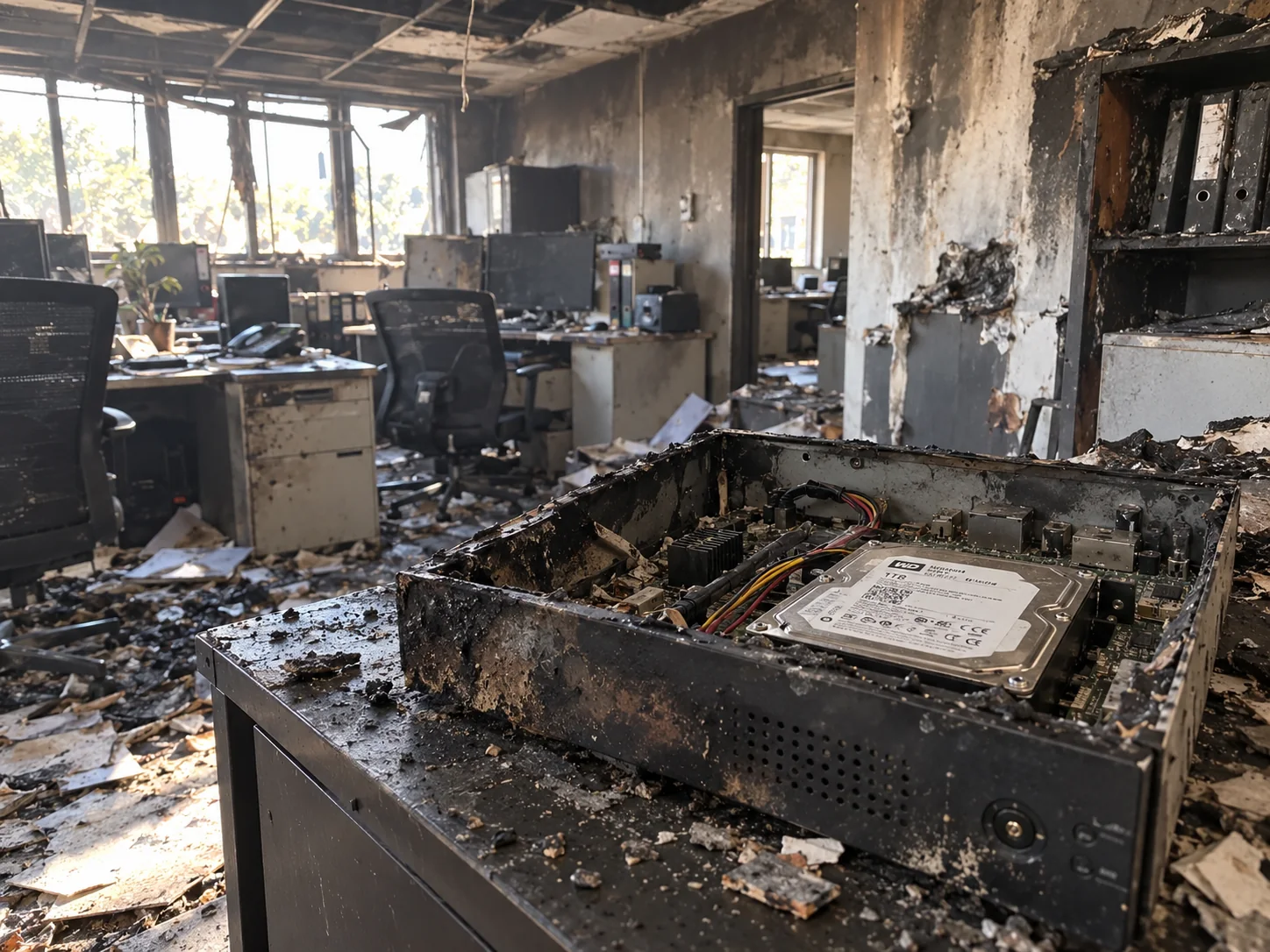
The condition of the room, recorder and enclosure helps reconstruct what the storage device may have experienced, but exterior damage alone does not tell us whether the data survived. A burned DVR can contain a hard drive whose chassis still looks surprisingly intact, while its electronics, heads, lubricant, plastics and magnetic media may all have been exposed to damaging heat.
The reverse is also true. A drive may have a scorched label, damaged PCB, melted connector or heavily contaminated exterior while the recording surfaces themselves remain readable. The question is not simply how burned the drive looks, but what temperatures reached the drive, for how long, and how that heat moved through the enclosure.
That is why the original DVR, NVR, computer or server can be useful evidence. Its location, enclosure damage, drive position and surrounding materials can help explain the thermal history before the hard drive is opened or tested.
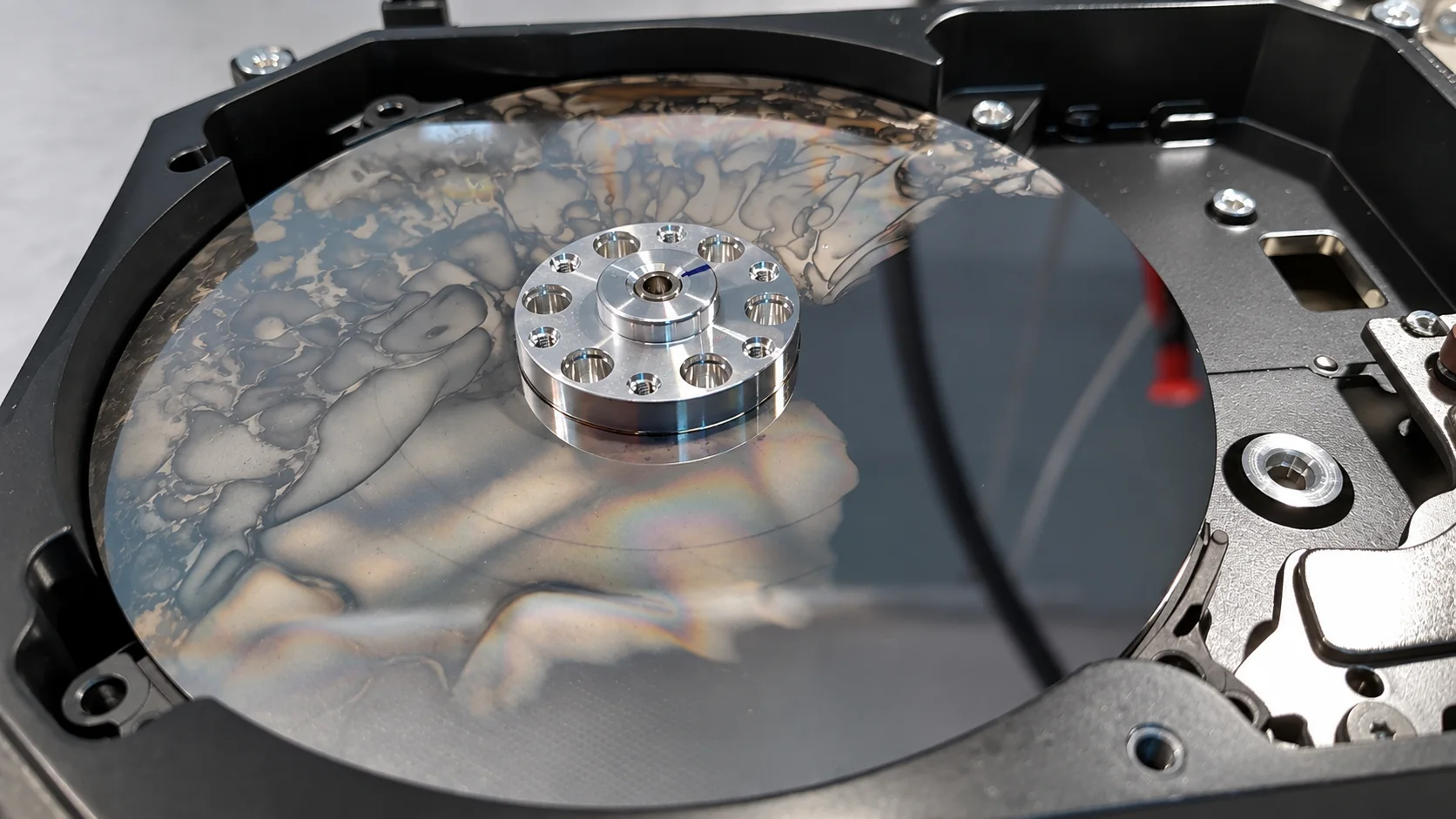
The platter photograph on this page is from an actual 10 TB Western Digital Purple surveillance hard drive examined after a fire. Visually, the recording surface still appears smooth and reflective. That appearance is useful, but it does not by itself establish that the magnetic recording is healthy.
Hard drives store data in an extremely thin magnetic layer on the platter surfaces. Heat can affect that recording long before a platter melts, visibly warps or develops dramatic discoloration. A platter can therefore look normal under ordinary visual inspection while the recorded signal has already weakened or become unreadable.
There is no single practical temperature that can be applied to every fire case. Media formulation, drive construction, local temperature, duration of exposure, whether the drive was operating, and the way heat was transferred through the recorder all matter.
In a surveillance system, recovering sectors from the hard drive is only the first part of the job. The recovered data may still depend on a proprietary recorder filesystem, video indexes, channel mappings, timestamps and recorder metadata before the footage can be interpreted correctly.
Fire adds another layer. The recorder enclosure may protect the drive from direct flame while trapping heat around it. A drive can therefore emerge from a badly damaged DVR with a relatively intact metal chassis while the internal head stack, parking ramp, electronics or magnetic recording have been thermally stressed.
Where several surveillance drives are installed, their original bay order should be preserved. Drives should not be rearranged, initialized or returned to a damaged recorder that may attempt to rebuild, format or alter the storage.
Whenever practical, preserve the recorder itself along with the drives. Its configuration and physical condition can be useful during both the technical recovery and interpretation of the recovered surveillance data.
A hard drive recovered from a fire may have suffered heat damage, electrical damage, smoke contamination, soot contamination and water exposure during the same incident.
Smoke and soot are not purely cosmetic. Combustion residue can be chemically aggressive and electrically conductive. Fine particles can contaminate PCB components, connectors, motor contacts, head contacts and internal filters. If residue reaches the inside of the drive, operation can introduce contamination into the head-to-media interface.
Fire suppression adds another layer of risk. Water from sprinklers, fire hoses or suppression systems can mix with soot, minerals, debris and chemical residue, creating both thermal and water-related damage in the same device.
Where suppression water or flooding is involved, the case must be evaluated using both fire-damage and water-damage protocols.
Water Damaged Hard Drive Data RecoveryThe incoming condition is documented first. Externally we examine the PCB, connectors, motor-control circuitry, carbonized areas, warped material, corrosion and fire-suppression residue. A burned PCB does not mean the data is gone, but drive-specific ROM or adaptive information may have to be preserved before donor electronics can be used correctly.
Significant fire exposure can also justify internal inspection before the platters are allowed to spin. The head-stack photograph on this page is from the same 10 TB WD Purple surveillance drive shown in the platter image. Inspection of the heads can reveal heat discoloration, deformation, damaged suspension components, residue, debris or other evidence that the original head stack is unsafe to use.
The head sliders fly only a tiny distance above the recording surface. A head that has been distorted, contaminated or mechanically weakened by heat can turn an otherwise recoverable case into platter damage if the drive is simply powered on. That is why internal condition matters before any attempt at normal startup.
Depending on what is found, recovery may require donor electronics, ROM transfer, replacement heads, cleaning, mechanical stabilization or transfer into a compatible donor chassis. Imaging begins only after the drive has been placed into a configuration that is safe enough to read.

Fire-related data recovery often overlaps with insurance claims, surveillance investigations, civil disputes, workplace incidents, vehicle fires and criminal matters. In those cases, the physical condition of the device may be relevant independently of the data stored on it.
The incoming state can be documented before cleaning or disassembly, including soot, burn patterns, melted connectors, corrosion, enclosure condition, DVR or NVR configuration, drive order and visible signs of previous handling.
If the device is connected to an insurance or legal matter, the required scope should be established before unnecessary cleaning, alteration or repair takes place. Data recovery and evidence preservation are related, but they are not the same objective.
Fire-damaged drives are not powered simply to see what happens. The recovery strategy is selected after the incident history, electronics, internal mechanism and recording media have been evaluated.
Record the incoming condition and establish what is known about the fire, enclosure, water exposure and previous handling.
Evaluate electronics and internal mechanics, then repair, clean, replace or transfer components only as required.
Controlled reads determine whether the magnetic recording remains viable after the drive has been placed into a safe recovery configuration.
When stable access is possible, sector-level imaging is prioritized before filesystem or surveillance-video reconstruction.
Yes. Data can sometimes be recovered even when the recorder or drive exterior has been badly burned. The decisive issue is whether the recording surfaces still contain readable magnetic information and whether the mechanics can be stabilized well enough to image the drive safely.
The photographs on this page illustrate exactly why appearance is not enough. The office and DVR show the severity of the fire scene, while the internal platter and head-stack photographs show components that still require separate technical evaluation. None of those photographs alone can determine the final recoverability of the data.
A meaningful assessment comes from combining the fire history, enclosure condition, electronics, internal mechanics, media condition and actual read behavior after stabilization.
Do not power on the hard drive and do not reconnect the DVR or NVR. Do not allow a recorder to initialize, rebuild or format the storage. If several drives are involved, keep them identified in their original bay or slot order.
Do not clean soot or residue if the device may be connected to an insurance, legal or investigative matter, and do not open the hard drive outside a controlled environment.
Preserve the original recorder or enclosure where practical. The most useful incident information is whether the equipment was in direct flame, where it was located, how long the fire lasted, whether suppression water was involved, whether the equipment was operating and whether anyone has already attempted recovery.
Sometimes. Severe exterior damage does not automatically mean the platter media was thermally destroyed. Recovery depends on whether the magnetic recording remains viable.
Yes. Sustained high temperatures can degrade the magnetic recording even when the exterior and platter surfaces still appear relatively normal.
No. Thermal damage depends on the recording media, drive construction, exposure duration, local temperature and other conditions. A single universal cutoff would be misleading.
No. The data is stored on the platter surfaces. The PCB may be repairable or replaceable, although drive-specific ROM or adaptive information may need to be preserved.
Yes. Soot and combustion residue can contaminate electronics and, if they reach the internal mechanism, can create additional risk to the heads and platter surfaces.
Yes. Fire-damaged drives are frequently also water-damaged. Suppression water can introduce corrosion, minerals, soot and other contamination that must be considered during recovery.
Potentially. Recovery may involve both the hard drives and reconstruction of proprietary recording structures, channel mappings, timestamps or indexes.
Yes, where practical. The recorder can contain configuration information that may help interpret recovered surveillance data.
Yes. Do not rearrange the drives or allow the recorder to rebuild, initialize or format the storage.
Yes. A protective enclosure may reduce direct flame exposure while still allowing internal temperatures to rise high enough to damage electronics, mechanics or magnetic media.
If a hard drive, DVR, NVR or other storage device has been exposed to fire, smoke, extreme heat or suppression water, stop powering it on and preserve it in its current condition.
Tell us what happened, what enclosure the drive was inside, whether direct flame or suppression water was involved, whether the device was operating during the fire and whether any previous recovery attempts have already been made.