
Steady Background Noise
Fans, ventilation, road noise and consistent electronic noise may sometimes be reduced while retaining usable speech.
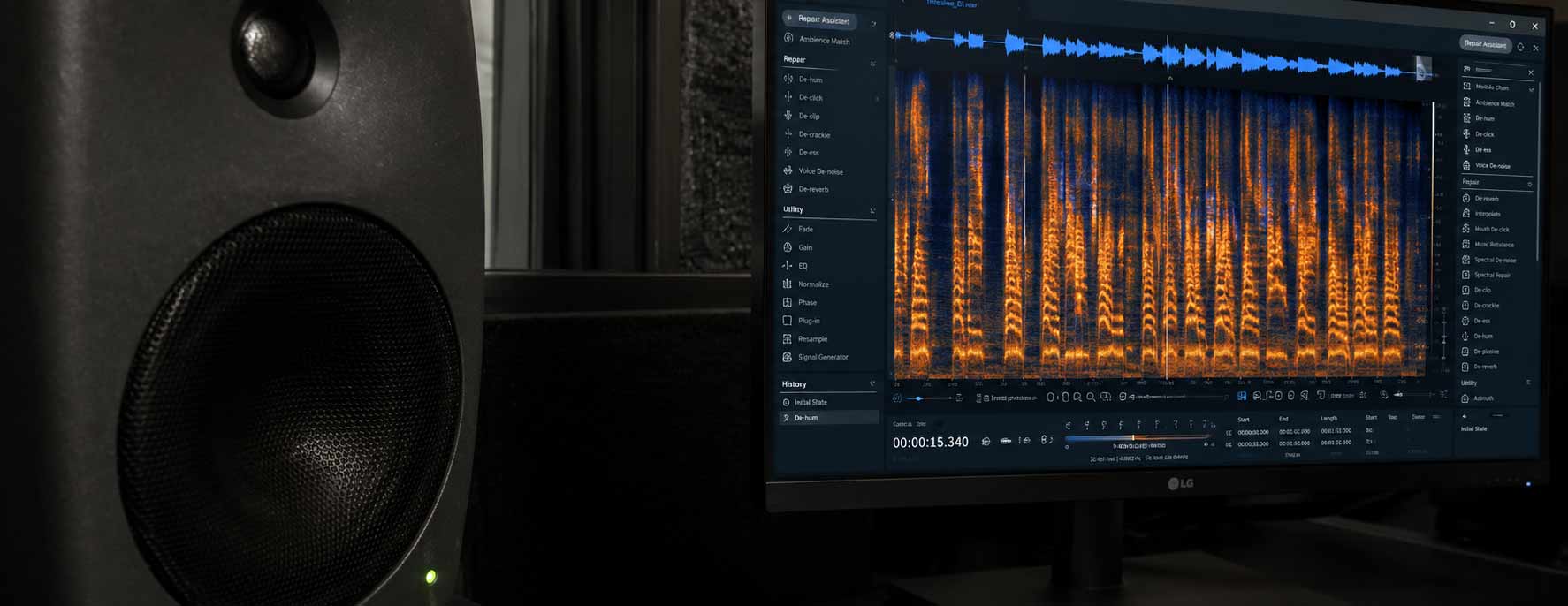
Aesonlabs improves the audibility and intelligibility of dialogue and other relevant sounds captured in difficult recordings. Each case is evaluated individually, processed from controlled working copies and documented so the relationship between the submitted source and every enhanced result remains clear.
Audio enhancement is used when speech or another important sound is present but difficult to understand because of noise, recording distance, reverberation, competing voices, music, mechanical interference or limitations of the recording device.
The objective is not simply to make the recording sound brighter or louder. Processing is selected according to the particular obstruction and the information the client needs to hear. A recording may require several controlled passes because settings that expose quiet consonants can sound very different from settings intended to preserve natural voice tone or environmental context.
Enhancement cannot create speech that was never adequately captured. Aesonlabs does not manufacture dialogue, treat software artifacts as words or force an interpretation simply to produce a desired result.
The degree of improvement depends on how strongly the desired signal was captured and how much it overlaps with the unwanted sound.
Fans, ventilation, road noise and consistent electronic noise may sometimes be reduced while retaining usable speech.
Electrical hum, low-frequency vibration, handling noise and other repetitive interference can be examined and treated selectively.
Low-level speech may be emphasized when sufficient vocal information exists above the useful noise floor.
Reflections in large, hard or echoing spaces may be reduced, although severe reverberation cannot always be separated completely.
Dialogue beneath music or environmental activity may sometimes be clarified when the sources do not fully mask one another.
Transient defects, clipping and short interruptions can be evaluated for repair or reduction without concealing material limitations.
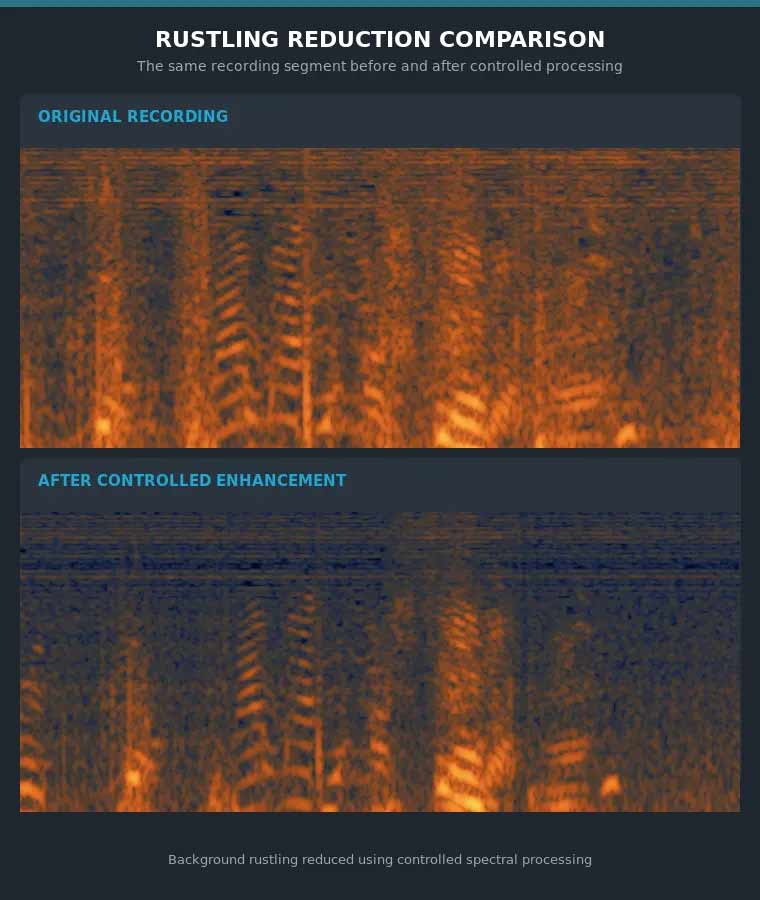
There is no universal enhancement preset. Steady fan noise behaves differently from overlapping speech, music, wind, water, impulsive sounds or constantly changing room noise. The source is inspected and listened to before a processing strategy is selected.
Rustling and handling noise are particularly variable because they can move through the same frequencies as speech. The illustrated passage is therefore treated selectively and compared with the original rather than subjected to one aggressive noise-removal setting.
Depending on the recording, work may involve controlled noise reduction, filtering, equalization, hum and rumble reduction, spectral repair, transient treatment, dialogue isolation, channel examination and level management. Automated or machine-assisted tools may be used as processing aids, but their output must be compared against the source because aggressive separation can introduce false detail and speech-like artifacts.
Where useful, separate versions can be prepared for different purposes—for example, one pass emphasizing maximum intelligibility and another retaining more natural background context.
The submitted source is retained unchanged and identified separately from all working material.
The recording, area of interest, competing sounds and requested objective are examined.
Targeted processing is performed in controlled stages rather than through one destructive filter chain.
Enhanced passages are compared repeatedly with the original to identify improvement and artifacts.
Versions, significant processing stages, findings and limitations are recorded for the engagement.
A recording initially submitted for private review can later become relevant to litigation, an investigation or a formal dispute. Controlled work from the beginning helps preserve a clear technical history if the engagement expands.
The original evidence is not overwritten. Source material, working files, intermediate versions and final deliverables remain distinguishable from one another.
Filename, format, size, available metadata and source identifiers
Client objective, relevant timestamps and questions being addressed
Software, processing stages and technically significant adjustments
Intermediate passes and final files identified with unambiguous names
Waveform or spectral images where relevant, together with listening observations
Residual noise, masking, artifacts and conclusions the recording cannot support
Cases may involve mobile-phone recordings, surveillance audio, interviews, meetings, voicemails, telephone calls, body-camera recordings, vehicle recordings, digital recorders, video soundtracks and other submitted audio. Original or earliest-generation files are strongly preferred because messaging applications, social platforms and repeated exports can remove metadata and introduce additional compression.
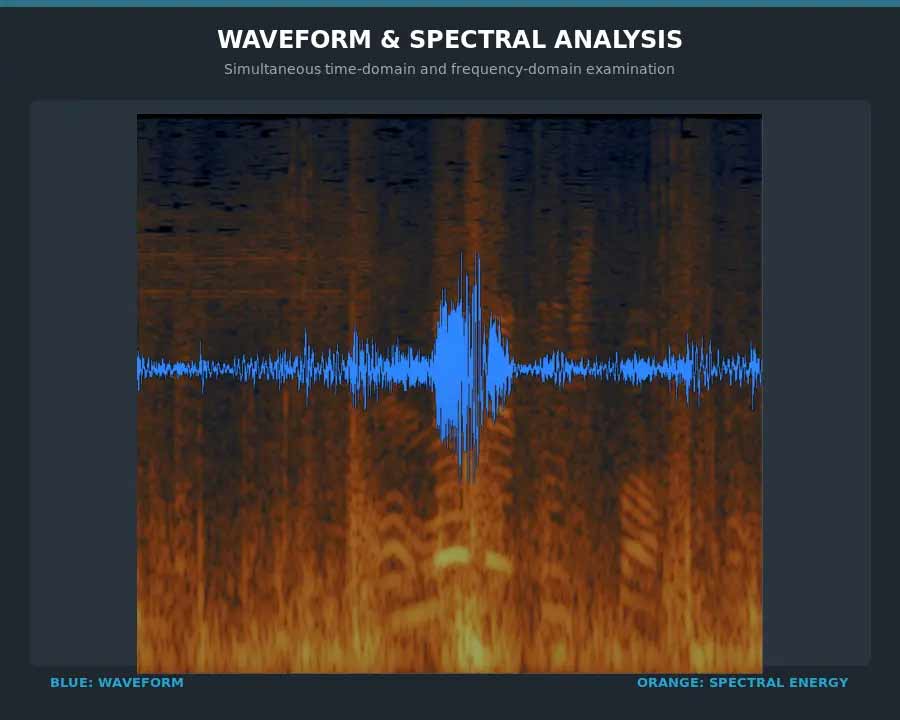
Initial evaluation combines controlled listening with waveform and spectral examination. The waveform shows amplitude and timing, while the spectrogram shows how recorded energy is distributed across frequency and time. Viewed together, they can help locate quiet passages, changing interference, transient sounds and areas where potentially useful speech information may remain.
Recording duration alone does not determine the difficulty of an enhancement. Five minutes of speech beneath steady fan noise may require less engineering than ten seconds containing distant dialogue, music, overlapping voices and changing interference.
Please provide the original recording whenever available, together with:
After reviewing the material and objective, Aesonlabs can define the appropriate scope and provide a quotation.
When formal documentation is required, a technical report can describe the submitted material, scope, methodology, relevant observations, processing performed and limitations of the result. The required report format and level of detail are established as part of the engagement.
Court attendance, testimony, preparation for examination or cross-examination, conferences with counsel and other litigation-related participation are not automatically included in the enhancement or report fee. These services are quoted separately according to the requirements of the proceeding.
Sometimes quiet or obscured speech can be improved substantially, but enhancement cannot recreate information that was never captured with sufficient signal. The recording must be evaluated.
Potentially. Results depend on the relative levels, frequency overlap, recording perspective and amount of independent information available for separation.
No changes are made to the preserved submitted source. Enhancement is performed on controlled working copies, and processed deliverables are identified separately.
No. A short, severely masked passage may require more work than a much longer recording containing steady and predictable noise. The source and objective must be reviewed first.
Significant processing stages, working versions, findings and limitations are recorded. The exact documentation and reporting scope is established according to the engagement and its anticipated use.
Legal use depends on the jurisdiction, proceeding and evidentiary requirements. Aesonlabs can preserve the source relationship and prepare technical documentation, but admissibility is a legal determination.
Include the approximate timestamp, the specific enhancement objective and whether the matter may require formal documentation.
Open an Audio Case