
Professional USB Flash Drive Data Recovery
Aesonlabs provides professional data recovery from failed, damaged and non-responsive USB flash drives. We recover data from conventional USB flash drives, monolithic flash devices and other removable flash storage affected by controller failure, NAND degradation, electronic faults, damaged connectors, firmware and translation problems, encryption, physical damage and logical corruption.
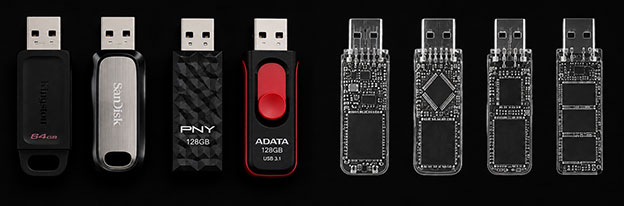
Although USB flash drives appear relatively simple from the outside, their internal construction can vary considerably. Some contain a conventional controller and separate NAND memory packages mounted on a printed circuit board, while others use highly integrated monolithic designs where much of the circuitry is embedded inside a single package.
The appropriate recovery method therefore depends on what is actually inside the device and why it stopped working. Diagnosis comes before selecting a controller-based, electronic, monolithic or direct NAND recovery procedure.
USB Flash Drive Problems We Recover
Flash drives can fail suddenly or gradually. Some become completely undetectable, while others begin disconnecting, freezing, reporting the wrong capacity or producing increasing numbers of read errors.
The same symptom can result from very different failures, which is why a non-responsive flash drive should not automatically be assumed to have a failed controller or damaged NAND memory.
USB Flash Drive Not Detected
A flash drive that no longer appears in Windows, macOS, Disk Management or another operating system may be affected by controller failure, firmware corruption, damaged NAND memory, an electronic fault or a problem with the USB interface.
Some controllers continue to provide diagnostic communication even when normal access to user data is unavailable. Other devices may be electrically dead and require component-level examination before communication with the controller or NAND can begin.
Broken USB Connector
USB connectors can become bent, broken or completely separated from the flash drive PCB. Physical damage can also tear solder pads and copper traces from the board.
When the damage is limited to the connector or surrounding circuitry, it may be possible to restore temporary electrical access or connect directly to appropriate PCB points for controlled imaging.
The condition of the PCB must still be inspected carefully because a physically damaged connector can also produce short circuits or damage components further into the device.
Flash Drive Gets Hot
Abnormal heat can indicate excessive current draw, a shorted component, controller failure, damaged power circuitry or another electronic fault.
A flash drive that becomes unusually hot should not be repeatedly plugged into different computers in the hope that it will begin working again.
Thermal imaging can be useful in these situations because localized heating may identify the region of the device responsible for abnormal current consumption before more invasive work is attempted.
Flash Drive Detected With the Wrong Capacity
A failed flash drive may continue to identify but report an incorrect capacity, generic device information or other abnormal parameters.
This can occur when the controller cannot correctly initialize its internal firmware, NAND configuration or logical-to-physical translation information.
Incorrect capacity can also occur with counterfeit or fake-capacity flash drives, which represent a completely different type of problem and are discussed separately below.
Flash Drive Freezing, Disconnecting or Producing Read Errors
NAND flash memory can become increasingly difficult to read as cells wear or degrade. The controller normally compensates through error correction, bad-block management and other internal processes, but severe degradation can eventually affect normal access.
A failing flash drive may become extremely slow, disconnect during file transfers or repeatedly disappear and reconnect.
When important data is involved, repeatedly restarting file copies or running stress tests can make an unstable recovery situation more difficult.
Liquid Damage and Corrosion
Flash drives exposed to water or other liquids can develop corrosion, short circuits and damaged electrical connections even when the device initially appears to continue working.
The device should be examined before repeated power is applied, particularly when corrosion is visible around the USB connector, controller, NAND packages or supporting circuitry.
Deleted, Formatted or Corrupted Data
Not every flash drive recovery involves failed electronics.
When the device remains physically healthy, recovery may be possible following accidental deletion, formatting, lost partitions or filesystem corruption.
The original device should still be protected from unnecessary writes because continued use may overwrite previously stored information.
How Professional USB Flash Drive Recovery Works
Professional flash recovery begins with determining the construction and actual failure of the device rather than immediately assuming that NAND memory must be removed.
1. Initial Diagnosis
The flash drive is inspected to determine its construction, physical condition, electrical behaviour and whether the controller is communicating normally.
Depending on the case, diagnosis can include examination of the USB connector, PCB traces, power rails, controller response, NAND configuration, current consumption and abnormal heating.
2. Thermal Imaging and Electronic Diagnosis
When a device is electrically abnormal or completely non-responsive, thermal imaging can help identify components or regions drawing excessive current.
A localized thermal hotspot can point toward a shorted capacitor, failed controller, damaged regulator or another problem within the power circuitry.
This can be particularly valuable because a device that appears completely dead may have an electronic problem rather than failed NAND memory.
3. X-Ray Examination
X-ray imaging can provide information that cannot be obtained from external inspection alone.
It can reveal internal copper routing, buried traces, vias, component locations and the construction of monolithic devices where important circuitry is hidden beneath protective material.
X-ray examination is especially useful when the physical structure of a device must be understood before material is removed or test points are exposed.
4. Controller Identification and Technological Access
If the controller remains responsive, the device is identified according to controller family, firmware behaviour and NAND configuration.
For supported flash architectures, professional recovery equipment such as PC-3000 Flash can provide controller-specific technological access that is not available through ordinary USB communication or consumer recovery software.
The available procedure depends on the actual controller, firmware and NAND combination rather than simply the brand name printed on the outside of the flash drive.
5. NAND Memory Acquisition
When controller-based recovery is not possible or appropriate, direct access to the NAND memory may be required.
On conventional designs, this can involve reading separate NAND memory packages. Monolithic devices require a different approach because the memory and associated circuitry may be integrated into a common substrate.
Obtaining a raw NAND dump is only the beginning of this type of recovery.
6. Raw NAND Reconstruction
The contents read directly from NAND memory do not necessarily resemble the logical flash drive originally presented to the computer.
Depending on the controller and architecture, reconstruction can involve error-correction processing, XOR or scrambling removal, page and block reconstruction, interleaving, bad-block handling and translation of physical NAND locations into the original logical address space.
Only after the controller-specific transformations have been sufficiently reconstructed can the resulting data begin to resemble the original logical storage device.
7. Filesystem Reconstruction and File Recovery
Once a usable logical image has been obtained, the resulting data is analyzed for partitions, filesystem structures, directories and files.
Whenever possible, filesystem reconstruction and file recovery are performed from the acquired image rather than repeatedly working from the original flash device.
Conventional and Monolithic USB Flash Drives
Not all USB flash drives are constructed in the same way.
Conventional Flash Drive Construction
A conventional flash drive typically contains a printed circuit board with a USB connector, flash controller, one or more NAND memory packages and supporting electronic components.
Because these elements are physically separate, individual components and electrical sections can often be examined directly during diagnosis.
Monolithic USB Flash Drives
Monolithic flash devices integrate the controller, NAND memory and portions of the supporting circuitry into a compact package or substrate.
There may be no conventional NAND package available to remove from the board. Instead, recovery can require identifying hidden internal routing and carefully exposing microscopic test points used to communicate with the NAND memory.
This type of work can involve microscopy, precision material removal, X-ray inspection and specialized flash recovery equipment.
Because important traces and internal structures may be hidden beneath the package material, understanding the internal construction before excavation begins is critical.
Flash Drive Controllers and PC-3000 Flash Recovery
The controller is responsible for managing NAND memory and presenting the raw flash storage to a computer as a conventional logical device.
Flash drives can use controllers from many different manufacturers and controller families. Even drives sold under the same retail brand or model name may contain different controllers, NAND memory or firmware across production revisions.
For this reason, recovery support cannot be determined reliably from the exterior branding alone.
Aesonlabs uses professional PC-3000 Flash technology for supported controller and NAND combinations. Depending on the architecture and failure, specialized access may provide functions required to obtain the memory contents or reconstruct the logical data.
Controller families found in USB flash storage can include devices from manufacturers such as Phison, Silicon Motion, Alcor Micro, ChipsBank, Innostor and others.
The exact controller, firmware and NAND configuration must be identified during diagnosis before an appropriate recovery method can be selected.
Unsupported, Unresearched and Unusual Flash Controllers
Not every flash controller has an established automated recovery solution.
New controller families, uncommon firmware revisions, low-cost flash devices and poorly documented components can present recovery situations where a ready-made technological procedure does not yet exist.
Some inexpensive or unusual flash drives may also contain remarked, relabelled or otherwise difficult-to-identify controllers and NAND memory.
A device is not automatically considered unrecoverable simply because the controller is not listed as supported by a particular recovery platform.
Electronic diagnosis, analysis of controller behaviour, direct NAND access and case-specific engineering may still provide another recovery path.
The feasibility of such work depends on the architecture, condition of the NAND and whether the controller-specific transformations can be understood or reconstructed.
NAND Flash Recovery and Reconstruction
Direct NAND recovery is considerably more complicated than simply removing a memory chip and copying its contents.
The flash controller continuously manages how information is physically stored within NAND memory. Logical sectors presented to the computer may be distributed across different physical pages, blocks, planes or NAND devices.
The controller can also perform error correction, wear levelling, bad-block management, data scrambling and other transformations.
A raw NAND dump may therefore contain the correct physical memory contents while still being completely unusable as a conventional filesystem image.
Depending on the architecture, reconstruction may involve:
- Error-correction processing and ECC analysis
- XOR or data-scrambling reconstruction
- NAND page and block structure analysis
- Interleave and multi-chip reconstruction
- Bad-block handling
- Controller-specific logical translation
- Reassembly of the original logical image
- Filesystem reconstruction and file extraction
This is why reading the NAND memory and recovering the files are two separate stages of professional flash recovery.
Encryption and USB Flash Drive Recovery
Encryption can significantly complicate flash recovery.
Some controllers perform internal data transformations or hardware encryption as part of normal operation. Other flash drives are specifically designed as encrypted or security-focused storage devices.
When encryption is tied to the original controller, obtaining a raw dump of the NAND memory does not necessarily provide usable user data.
Successful recovery may depend on preserving or restoring the original controller's ability to interpret the NAND or reproducing the required controller-specific transformations.
Flash drives using additional password-based or hardware security systems may also require the appropriate password, encryption key or other credentials before recovered logical data can be accessed.
Why X-Ray and Thermal Imaging Matter
A completely dead flash drive does not automatically have a failed controller or failed NAND memory.
Before applying heat, removing NAND packages or excavating a monolithic device, it is often useful to understand why the device is not operating normally.
Thermal imaging can reveal abnormal current consumption and localized hotspots, while X-ray examination can show hidden traces, internal routing and component relationships that are invisible from the surface.
These diagnostic methods can help distinguish an electronic problem from a controller or NAND failure and can prevent unnecessary invasive work.
Aesonlabs has used this approach successfully in monolithic flash cases where the initial symptom was simply a completely non-responsive device.
In one documented case, thermal imaging and X-ray examination helped narrow the fault to microscopic components in the power circuitry. Once the fault was repaired, the controller initialized normally and the original filesystem became accessible.
View our Monolithic Flash Data Recovery Case Study
Fake-Capacity and Counterfeit USB Flash Drives
Not every corrupted flash drive actually contains the storage capacity printed on the label.
Counterfeit and fraudulent flash drives can be programmed to report a much larger logical capacity than the amount of physical NAND memory installed inside the device.
For example, a drive advertised as hundreds of gigabytes or even several terabytes may contain only a fraction of that amount in genuine flash memory.
The operating system initially accepts the reported capacity, but once writes exceed the real physical NAND capacity, new information may overwrite previously stored data or be directed to storage locations that do not actually exist.
The result can appear as widespread file corruption, missing photographs, unreadable videos or directories that exist but contain damaged files.
Recovery from a fake-capacity device depends on the genuine NAND contents that remain physically available. Data that was overwritten because of fraudulent capacity reporting cannot be recreated from storage locations that never existed.
Logical USB Flash Drive Recovery
Flash drives can also suffer logical data loss while the controller, NAND and electronics remain functional.
Examples include deleted files, accidental formatting, lost partitions and damaged FAT, exFAT, NTFS or other filesystem structures.
A physically healthy flash drive presents a very different recovery situation from one that is unstable, overheating or repeatedly disconnecting.
For that reason, the physical condition of the device should be established before aggressive filesystem repair or recovery utilities are used.
USB Flash Drives and Devices We Recover
Aesonlabs works with a wide range of USB flash storage devices and configurations.
Recovery is available for:
- USB-A flash drives
- USB-C flash drives
- Conventional controller and NAND flash drives
- Monolithic USB flash drives
- Dual-interface USB-A / USB-C drives
- Encrypted and security-oriented flash drives
- Promotional and generic USB flash drives
- Flash drives with damaged USB connectors
- Flash drives with liquid or physical damage
- Counterfeit and fake-capacity flash storage
- Flash storage removed from specialized devices where technically supported
We work with devices from manufacturers including SanDisk, Kingston, Lexar, Verbatim, PNY, ADATA, Corsair, Transcend and many other current and legacy brands, as well as unbranded and generic flash storage.
The manufacturer name alone does not determine the recovery procedure because different production revisions can contain completely different controller and NAND combinations.
What Not to Do With a Failed USB Flash Drive
What happens after a flash drive begins failing can affect the eventual recovery result. If the device contains important data:
- Do not repeatedly plug and unplug a flash drive that is overheating or repeatedly disconnecting.
- Do not initialize or format the device because the operating system asks you to.
- Do not run CHKDSK or filesystem-repair utilities on an unstable flash drive.
- Do not continue large file-copy attempts when the device repeatedly freezes or disappears.
- Do not apply uncontrolled heat to the controller or NAND memory.
- Do not remove NAND memory simply because the device is not detected.
- Do not attempt to scrape or expose monolithic test points without understanding the internal layout.
- Do not resolder a damaged USB connector repeatedly if PCB pads or traces have already been torn.
- Do not write new data to a flash drive containing deleted or accidentally formatted files.
The safest procedure depends on whether the failure is electronic, controller-related, NAND-related, monolithic, physical or logical, which is why diagnosis comes first.
Why Aesonlabs for USB Flash Drive Recovery?
USB flash drive recovery is performed directly by Aesonlabs rather than being forwarded to an unknown third-party laboratory. Each device is evaluated according to its actual construction, controller, NAND configuration and failure rather than simply by the brand or capacity printed on the enclosure.
Our flash recovery work can involve electronic diagnosis, thermal imaging, X-ray inspection, microscopic PCB work, PC-3000 Flash technological access, monolithic recovery, direct NAND acquisition and controller-specific reconstruction.
Devices containing unusual or unsupported controllers are evaluated individually rather than being automatically rejected because a ready-made recovery procedure does not exist.
Customers also have access to a case-management portal where the progress of an active recovery case can be followed using the unique case number assigned when the device is submitted.
For customers who cannot bring a flash drive directly to our laboratory, shipping options are available throughout Canada. Local delivery and pickup options may also be available depending on location and case requirements.
Starting a USB Flash Drive Recovery Case
To begin, submit a recovery case with information about the flash drive and what happened before the data became inaccessible.
If the device has been physically damaged, exposed to liquid, repaired previously or has already been opened by another laboratory, include that information when submitting the case.
Once the case is created, you will receive a unique case number and instructions for delivering or shipping the device to Aesonlabs.
After diagnosis, we can determine the type of failure and the most appropriate recovery procedure.
USB Flash Drive Data Recovery FAQ
Potentially. A completely non-responsive flash drive may have a failed USB connector, damaged power circuitry, controller failure, firmware problems or NAND-related faults. Diagnosis is required to determine which part of the device has failed and what recovery options remain.
Often, yes. If the damage is limited to the USB connector or surrounding PCB traces, temporary electrical access may be restored for controlled imaging. More severe damage may require trace reconstruction or another method of communicating with the controller and NAND.
A monolithic flash drive integrates the NAND memory, controller and portions of the supporting circuitry into a compact package rather than using separate conventional NAND chips on a PCB. Recovery can require X-ray inspection, microscopic material removal and access to hidden test points within the monolithic package.
Depending on the controller, NAND configuration and failure, recovery may still be possible. Some devices can be accessed through controller-specific technological modes, while other cases may require direct access to NAND memory and reconstruction of the controller's data transformations.
Lack of a ready-made technological solution does not automatically mean that the flash drive is unrecoverable. The device can still be evaluated for electronic faults, controller behaviour, NAND accessibility and other recovery possibilities. The result depends on the specific controller, NAND architecture and failure.
In some cases, yes, but reading NAND is only one stage of the process. Raw NAND data can require error correction, XOR or scrambling reconstruction, block and page reassembly, interleave reconstruction and controller-specific translation before the original logical data becomes accessible.
Flash controllers do not normally store data in NAND as a simple sequential copy of the filesystem. They manage wear levelling, error correction, bad blocks, interleaving, scrambling and logical-to-physical translation. The raw NAND contents therefore have to be reconstructed before they can resemble the original USB storage device.
Potentially. Recoverability depends on the type of encryption, controller architecture, condition of the device and availability of any required password or encryption key. Controller-level encryption can also make raw NAND recovery significantly more complicated.
Sometimes. Recovery is limited to data that actually exists within the genuine physical NAND capacity. Information overwritten after the controller exceeded the real memory capacity cannot be recovered from storage locations that were never physically present.
Depending on the filesystem, device architecture and subsequent use, deleted data may remain recoverable. Continued use can overwrite information that would otherwise remain available, so the flash drive should not be used when the missing data is important.
Thermal imaging can identify abnormal heat and current consumption, while X-ray imaging can reveal buried traces, internal routing and hidden structures. These diagnostic tools can help establish the actual failure before invasive procedures such as NAND removal or monolithic excavation are attempted.
Recovery time depends on the construction of the device, controller family, NAND condition, type of failure and whether electronic repair, monolithic work or raw NAND reconstruction is required. A more meaningful estimate can be provided after the device has been diagnosed.
Get Your USB Flash Drive Evaluated
If your flash drive has stopped detecting, has a damaged USB connector, becomes unusually hot, repeatedly disconnects, reports the wrong capacity or contains inaccessible data, avoid unnecessary repair or repeated testing attempts.
Submit a case to Aesonlabs with the device information and symptoms you have observed. We will evaluate the construction and failure of the flash drive and determine the appropriate recovery procedure.