
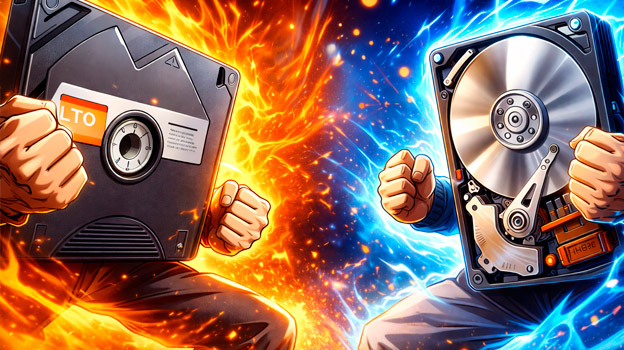
Many people assume that magnetic tapes like LTO, DVS, and similar formats are used the same way as hard drives. That is the biggest misconception I see, and it is usually the reason why tape recovery cases become so complicated. While both store data, the way they behave when it comes to access, structure, and recovery is fundamentally different.
Below is a practical breakdown of why tapes and hard drives live in two completely different worlds.
Sequential vs Random Read Access
The most important difference is how data is read.
Tape is sequential, meaning the drive can only read data in order from the beginning of the tape to the end. If you are only after one specific file or folder, you still have to process the entire tape before reaching that point. In many cases, the tape must first be imaged in full so an index can be rebuilt before any meaningful recovery can begin. This process alone can take many hours, sometimes days, depending on the tape length and condition.
Hard drives, on the other hand, use random access. The read heads can jump directly to the sector that contains the file you want. This gives you the freedom to copy files in any order, and in many situations makes partial or targeted recovery possible. In practice, this is often the difference between a long forensic-style process and a relatively quick extraction.
File Systems & Data Management
Hard drives rely on well-known file systems such as NTFS, FAT, exFAT, HFS, and APFS. These structures are well documented and predictable. For example, NTFS uses a Master File Table that maps every file to its physical location on disk. Even when a file system is damaged, it can often be reconstructed because the logic is consistent and widely understood.
Tape, however, primarily uses LTFS (Linear Tape File System). LTFS splits the tape into two logical partitions: one that holds the metadata and index, and another that contains the actual data. Unlike NTFS, the file system on tape is closely tied to the physical layout of the media. If the index partition becomes corrupted or incomplete, interpreting the tape correctly becomes significantly more difficult.
Plug & Play vs Specialized Environments
Hard drives are generally plug and play. Whether through USB, SATA, or older IDE connections, most systems will recognize the drive automatically and allow you to access the data almost immediately.
Tapes are a completely different environment. Before you can even see the contents, you must have a compatible tape drive and the correct software platform. In many real cases, this means enterprise backup systems such as BackupExec, Veeam, or Commvault. Without the right combination of hardware and software, the data on the tape may not even be visible. This is why tape storage is not considered user friendly and why prior experience is strongly recommended when working with tape archives.
Archiving Methods & Data Recovery Challenges
One of the biggest unknowns with tape recovery is how the data was originally archived. If the backup software and method are known, it is often possible to reconstruct the environment and extract the data. However, in many cases the original system is no longer available, or the tape was written using a custom or proprietary solution.
When that happens, standard recovery tools are often useless. Sometimes custom recovery software must be written just to interpret the data structure. In certain cases, even with deep analysis, it is not possible to fully determine how the data was stored. This is where tape recovery becomes significantly more complex than hard drive recovery.
Storage Longevity
Tapes do have one major advantage: longevity. When stored in proper environmental conditions, magnetic tapes can retain data for 30 years or more. Hard drives, by comparison, typically have a usable life expectancy of around 4 to 6 years. This is why tape is still widely used for long-term archival storage in enterprise environments.
Final Thoughts
Although both tapes and hard drives store data, they serve very different purposes. Tape is ideal for long-term archival data that is rarely accessed. Hard drives are better suited for active data that must be accessed quickly and frequently.
Hard drives are user friendly and flexible. Tapes require planning, specialized tools, and experience. When something goes wrong, recovering data from tape is rarely simple — and almost never quick.